Leaking tank or no hot water: which one are you dealing with?
Water heater repair means finding out why a tank stopped heating or started leaking, then replacing the part that failed. In Shelbyville, Indiana the usual culprits are a dead heating element, a worn thermostat, a burned-out thermocouple, a rusted drain valve or a corroded tank.
The two complaints look alike from the shower but they are very different jobs. No hot water is often a cheap part. A tank that is leaking from its own shell usually is not repairable, and we will tell you so before any work starts.
Water pooling around the base
Check the fittings on top first. If the water is dripping from the bottom of the jacket, the steel tank has likely rusted through.
Warm water that runs out in minutes
On an electric heater a failed lower element is the classic cause. On a gas unit, look at sediment packed around the burner chamber.
Pilot will not stay lit
A weak thermocouple or a draft near the combustion air inlet. A gas smell means leave the house and call 911 first.
Breaker trips when the heater runs
A shorted element or a loose wire at the thermostat. Leave the breaker off until a plumber checks it.
Rumbling or popping from the tank
Mineral scale at the bottom of the tank trapping steam bubbles. It means the heater is working harder than it should.
Rust-colored or smelly hot water
A spent anode rod is the usual cause. Replacing it can add years to a tank that is otherwise sound.
Before we arrive
Four steps that limit water damage and keep you safe.
Cut the power or gas
Flip the dedicated breaker off for an electric heater. On gas, turn the control knob to OFF. If you smell gas, leave the house and call 911 and your gas utility, then call us.
Close the cold supply valve
The valve sits on the pipe feeding the top of the tank. Turn the handle until it stops. That ends the flow into a leaking tank.
Do not drain the tank unless a hose is attached
Water inside can be hot enough to scald. If the tank is leaking badly, connect a garden hose to the drain valve, run it to a floor drain or outside, and open the valve slowly.
Move what the water can reach
Basement heaters sit on concrete, but boxes and furnace parts sit nearby. Lift cardboard off the floor and keep a mop or wet vac ready.
How a plumber works out what failed
We start with the water, not the tank. A leak that looks like the heater is often a weeping fitting, a dripping relief valve or condensation on a cold pipe, and none of those need a new tank.
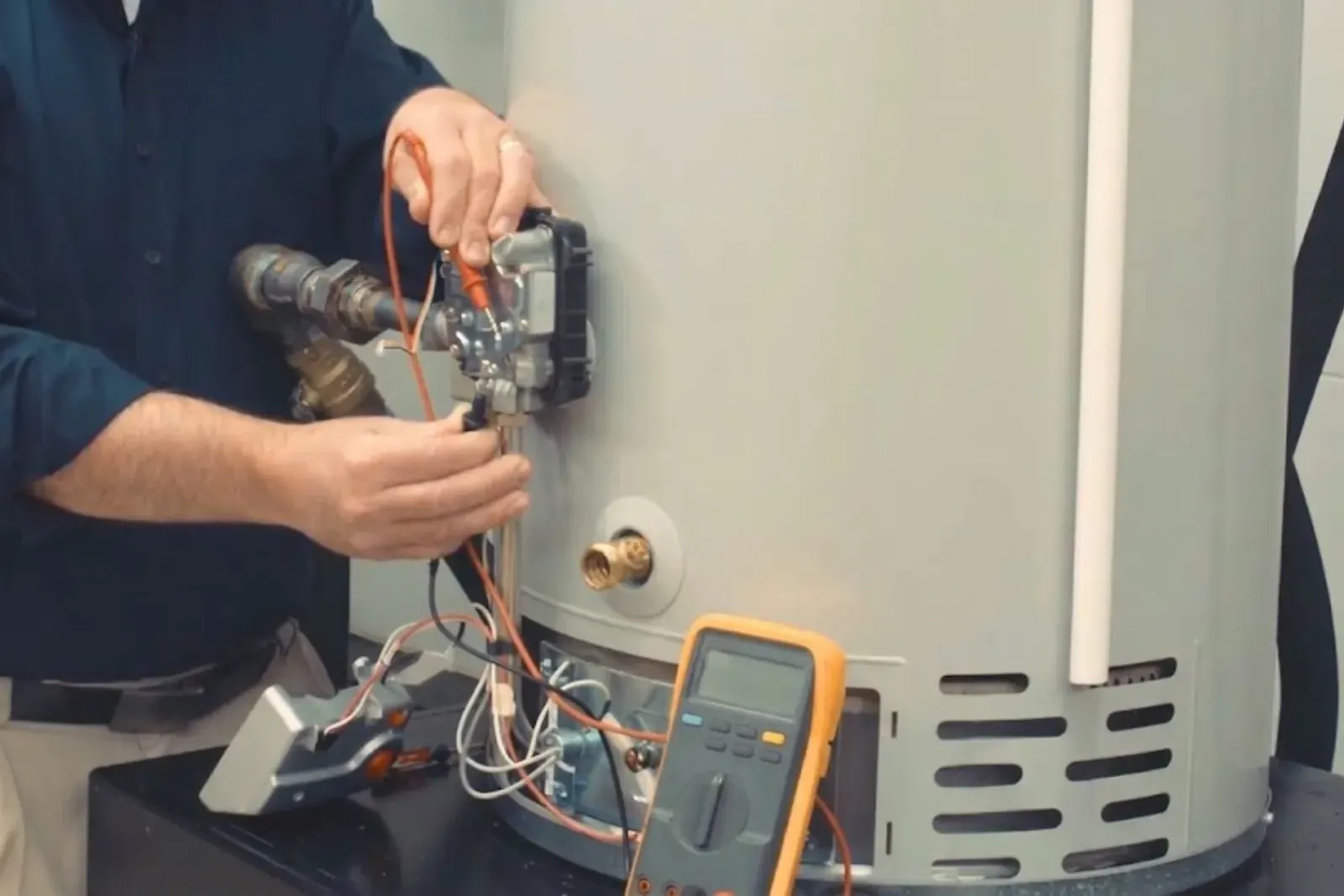
Then comes testing. A multimeter checks each element and thermostat on an electric unit. On gas, we check the thermocouple output, the gas valve and the flue draft with a mirror or smoke pencil. Sediment shows up as a gritty flush from the drain valve.
Look for the water's true source
Dry every fitting with a rag and watch where the first drop forms. Top fittings, the T&P valve and the drain valve are checked before the shell.
Test the electrical or gas side
Element resistance, thermostat continuity and breaker amperage on electric. Pilot flame, thermocouple millivolts and burner condition on gas.
Flush a sample from the drain valve
Rust flakes, white grit or black sludge each tell a different story about tank age and water quality.
Give you the options and the price
You hear what is broken, what it costs to fix and whether a replacement makes more sense before anything is opened up.
Replacement parts should match the label on your tank. A temperature and pressure relief valve is made to ANSI Z21.22 and must never be capped or plugged, because it is the safety device that opens when pressure climbs. Gas storage heaters are certified to ANSI Z21.10.1 and electric tanks are listed to UL 174, so ask for parts that suit that listing.
On gas models the flue and gas piping work is guided by NFPA 54, the National Fuel Gas Code. That is why a plumber checks draft and leak tests every joint before leaving. After any thermostat work, the U.S. Consumer Product Safety Commission advises a setting of no more than 120 degrees Fahrenheit to reduce scald risk.
Gas, electric and hybrid heaters fail in different ways
The fuel decides which parts wear out first. Most Shelby County homes run a standard 40 or 50 gallon tank, though hybrid heat pump models are showing up in newer remodels.
| Heater type | Parts that usually fail | What the repair involves |
|---|---|---|
| Electric tank | Upper or lower heating element, thermostat, high-limit reset | Drain below the element, swap it, refill and bleed air. Often under an hour of work. |
| Gas tank | Thermocouple, gas control valve, pilot assembly, flue baffle | Parts swap with a draft and leak check. Gas valve failures cost more than thermocouples. |
| Hybrid heat pump | Condensate drain, fan, compressor, sensors, elements | Needs clear air around the unit and a working condensate line. Some faults need the maker's service channel. |
| Any tank | Anode rod, T&P relief valve, drain valve, dip tube | Cheap parts that prevent expensive tank failures when swapped before the shell rusts through. |
Hybrid heat pump heaters need breathing room
A hybrid unit pulls heat from the air around it, so a closet with no airflow makes it run on its resistance elements and the electric bill climbs. If your hybrid is cooling the room it sits in and still delivering lukewarm water, call us. A ducting or filter problem is often cheaper to fix than a compressor.
What goes wrong with tanks in Shelbyville homes
Houses in the West Side Historic District were built between 1853 and 1939, and many have been remodeled with water heaters tucked into basements or utility closets that were never designed for them. Cramped spaces mean poor venting and tanks that are hard to inspect. If your tank is wedged behind a furnace or under stairs, tell dispatch so we bring the right tools.
Hard water is the other local worry. Mineral scale builds on the bottom of every tank over time and insulates the water from the burner or lower element. Test your tap with an inexpensive hardness kit, and ask Indiana American Water for its annual water quality report so you know what is arriving at your house.
What decides the cost of a water heater repair
A simple element swap and a tank that has rusted through are very different bills. These are the factors that move the number.
Homeowner policies usually cover sudden water damage from a burst or failed appliance but often exclude the heater itself and slow leaks that went unnoticed. Check your policy and photograph the damage before cleanup.
No hot water and the kids need a shower?
Call the 24/7 line and tell dispatch whether your heater is gas, electric or hybrid. We will say what to check while a plumber heads your way.
Repair it or replace it: how to decide
Repair makes sense when
- The tank itself is dry and sound
- A single part failed, such as an element or thermocouple
- The heater is under about 10 years old
- No rust shows in the drain sample
- The flue and venting still meet code
Replace instead when
- Water leaks from the tank shell or seam
- The unit is past 12 to 15 years old
- Repeated repairs in one year
- The tank is packed with scale or sediment
- You are changing fuel type or going tankless
If the answer is replace, our water heater replacement page explains the process, and a planned swap is covered under water heater installation. Homeowners who want endless hot water can read about tankless options.
After-hours failures, and why they cluster in cold weather
Heaters fail most when they work hardest. Indiana winters pull incoming water temperature down, so a tank runs longer to deliver the same shower and an old element finally gives out on a January morning. We take calls overnight and on weekends and offer same-day appointments when available.
We also serve Morristown, Fairland and the surrounding Shelby County area, so tell dispatch your address and the fuel type when you call.
Water heater repair questions from Shelbyville homeowners
Yes. Our dispatch line runs 24/7, and we book same-day appointments when available. Tell the dispatcher whether water is actively leaking and whether the heater is gas, electric or hybrid so the plumber arrives with the likely parts.
Usually not. Water from the bottom of a steel tank typically means the inner lining has corroded through, and no patch fixes that. First confirm the water is not coming from the drain valve or a top fitting, since those are repairable.
The common causes are a worn thermocouple, a dirty pilot orifice or a draft blowing across the combustion air inlet. If you smell gas at any point, leave the house and call 911 and your gas utility before calling us.
Check the breaker, then the red reset button on the upper thermostat. If both are fine, the upper element or thermostat is usually dead. Lukewarm water points to the lower element instead.
Not usually, but it signals sediment trapped under the tank bottom. Flushing helps if the tank is otherwise healthy. If the noise comes with leaks or a hot relief valve discharge, shut off power or gas and call.
Mineral scale can coat elements and fill the tank bottom, which shortens heater life and raises energy use. Test your tap, and ask Indiana American Water for its annual water quality report if you want details on your supply.
We handle the plumbing and electrical sides, such as condensate lines, elements, relief valves and clearance problems. Sealed system faults may require the manufacturer's service channel, and we will tell you so up front.