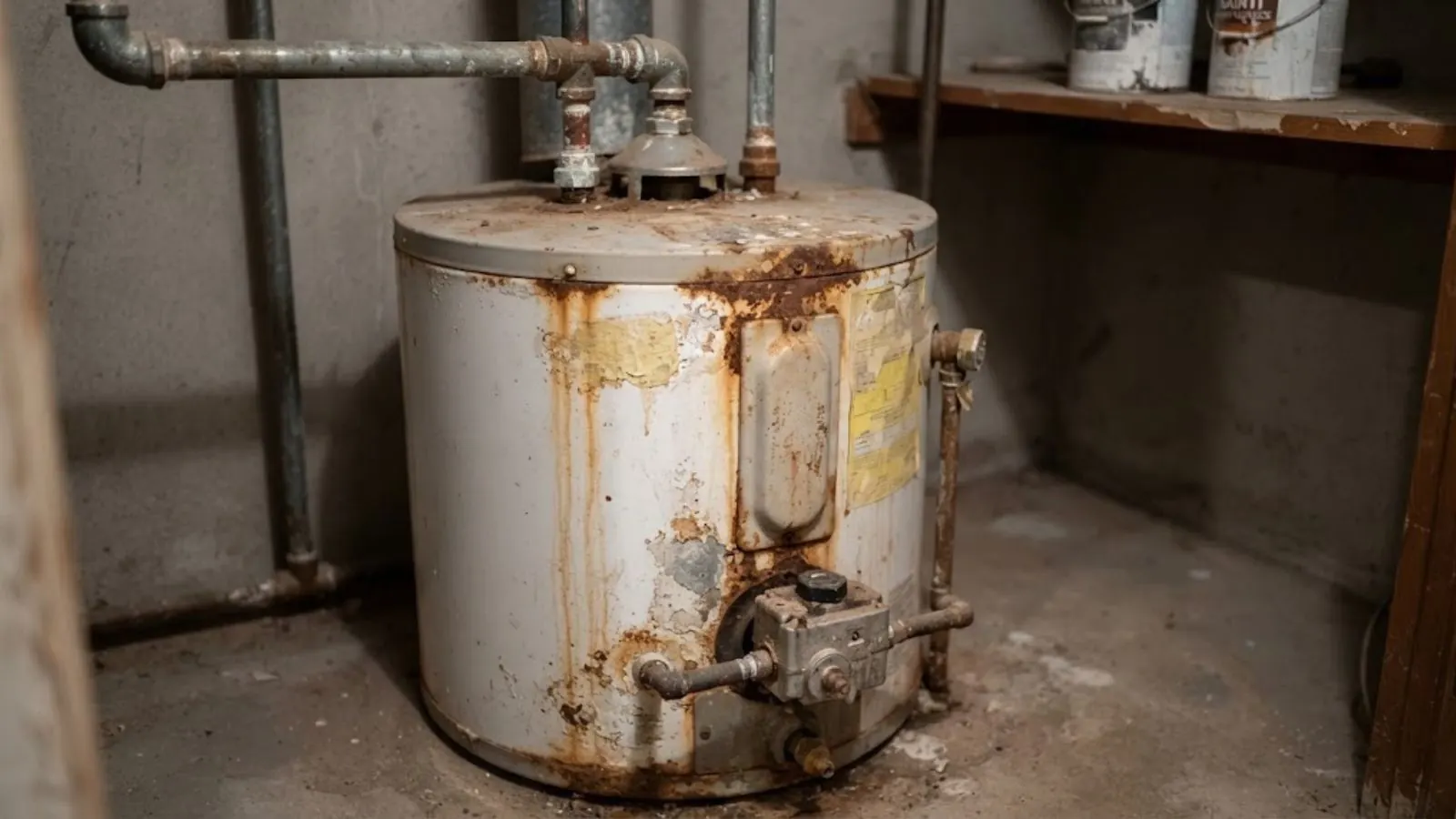
Your tank gave out: what happens next
Water heater replacement is removing a failed tank, setting a new one of the right size and fuel type, and reconnecting the water, gas or electric, venting and safety valves to code. In Shelbyville, Indiana the tank is usually in a basement, garage or utility closet, which decides how fast the job goes.
A typical failure shows up as a puddle that grows or a rusty stream at the base of the jacket. You will hear a plumber ask three things first: gas or electric, what size is the label, and where does the water go if it spills.
Do this before the plumber gets there
Short steps that protect your floor and your family.
Shut off the fuel
Turn the breaker off or the gas control to OFF. If you smell gas, get everyone outside, call 911 and your gas utility, and then call us.
Stop the cold water
Close the valve on the cold line above the tank. If that valve will not turn or leaks, find the main shutoff where the line enters the house.
Save the label photo
Take a picture of the data plate on the side of the tank. Capacity, input rating and model number let dispatch line up a matching unit before the truck rolls.
Clear a path
Move boxes, shelves and laundry baskets away from the heater and the stairs. A 50 gallon tank weighs about 400 pounds when full, and we need room to walk the old one out.
Repair or replace: the decision, row by row
| What you found | Usual answer | Why |
|---|---|---|
| Water coming from the tank shell, seam or bottom | Replace | A corroded steel liner cannot be patched. Fixing the visible drip does not stop the next one. |
| No hot water, tank is dry and under about 10 years | Often repair | An element, thermostat or thermocouple costs far less than a new tank. See water heater repair. |
| Rumbling, rusty water, tank 12 years or older | Lean replace | Heavy scale and a spent anode rod mean the tank is near the end of its life. |
| Leak from a fitting, relief valve or drain valve | Repair | A part swap often stops it. We confirm the shell is dry first. |
| Third repair in a year | Replace | Chasing parts on a worn tank costs more than the tank over time. |
That table is a starting point. The final call depends on what the plumber sees with the jacket and insulation pulled back, and we explain it before you commit to anything. Whatever you choose, set the new thermostat at no more than 120 degrees Fahrenheit, the level the U.S. Consumer Product Safety Commission advises to reduce scald risk.
What a same-day swap looks like
Confirm size and fuel
Most homes get a like-for-like tank, usually 40 or 50 gallons. A larger household or a soaker tub may justify stepping up.
Drain and disconnect
The old tank is drained to a floor drain or outside by hose. Water lines, the gas line or electrical whip, and the flue are disconnected.
Set and plumb the new heater
New flexible connectors or copper, a fresh T&P relief valve with a discharge line, and a drain pan where the space calls for one.
Vent, fire up and test
On gas, the flue gets a draft check and every joint a leak test. On electric, the tank is filled completely before power goes on, so the elements never run dry.
Haul the old tank away
We carry out the failed unit so you are not left with a rusted tank in the garage.
Why the tank must be full before electric power goes on
An electric element burns out in seconds if it heats air instead of water. We open a hot tap and let it run steadily before flipping the breaker, which purges air from the tank and protects the new elements.
New tanks carry their test standard on the label. Typical home gas storage heaters are certified to ANSI Z21.10.1 and electric tanks are listed to UL 174. The temperature and pressure relief valve is made to ANSI Z21.22 and needs a discharge line piped toward the floor, never capped. Gas piping and venting follow NFPA 54, the National Fuel Gas Code, so every joint is leak tested and the draft is checked before we leave.
Choosing the replacement
Standard tank
- Lowest first cost of the three common types
- Same hookup as most existing heaters
- Gas or electric
- Holds a fixed supply and recovers slowly after a big load
Other routes
- Tankless heats on demand and needs gas line and venting review
- Hybrid heat pump models use less electricity but need airflow and a condensate drain
- Both usually cost more up front and take more planning than a straight swap
In an emergency most people want the same type back quickly. If you would like to upgrade, a planned job is cheaper to engineer, and our water heater installation page covers venting, expansion tanks and permits in detail.
Flooded basements and slab-level heaters in Shelby County
Shelbyville sits at the fork of the Big Blue and Little Blue Rivers, and the city flood page warns that low ground near the Big Blue can take water in high river stages. A heater sitting at slab level in a flood-prone basement can be ruined by water long before the tank wears out. If yours was submerged, even a clean-looking unit should be replaced, because gas valves and thermostats do not recover from soaking.
Raising a replacement tank on a pedestal a foot or so above the floor is a simple improvement during a swap.
What drives the price of a replacement
Two homes can both get a 50 gallon heater and see very different totals. These are the reasons.
Insurance usually pays for sudden water damage to floors and belongings from a burst tank but not for the heater itself, which is treated as normal wear. Photograph everything before cleanup and read your policy for water damage wording.
Tank down and water everywhere?
Call the 24/7 line. We will tell you what to shut off, ask for the data plate details and book the earliest same-day slot we have.
Permits and who may pull them
In the city of Shelbyville, only registered plumbing contractors can apply for plumbing permits, and a homeowner working on a home they own and live in must get a permit first. The work is held to the Indiana Plumbing Code, which the city lists as the 2012 edition. Elsewhere in Shelby County the rule can differ, so ask the building department. A licensed plumber handles the permit so your new heater is on record.
We serve homes across Shelbyville, plus Morristown and Waldron. After-hours replacements follow the same steps, though parts availability can stretch a late-night job into the next morning.
Replacement questions we hear when a tank fails
Yes. Dispatch runs 24/7 and we offer same-day appointments when available. At night we can make the situation safe and set the new heater as soon as a matching unit is on the truck. Tell dispatch the data plate details.
A like-for-like swap in a reachable spot is usually a few hours. Venting repairs, a new gas line, a relocated tank or stairs with tight turns take longer.
Yes, but it is not a swap. Gas needs a gas line, a flue and combustion air. Electric needs a dedicated circuit of the right amperage, which may need an electrician.
Top leaks are often fittings, the relief valve or a dripping inlet and are cheaper to fix than the tank. A plumber should dry and inspect everything before calling the tank dead.
If your home has a closed system, such as a pressure-reducing valve or a backflow device on the main, a thermal expansion tank is the usual solution and is required by some local codes. We check this at the swap.
Yes. We drain it, carry it out and dispose of it so you are not left with it in the basement.
If water reached the burner, gas valve or electrical connections, yes. Those components can fail later even if the heater seems to run, so replacement is the safe route.