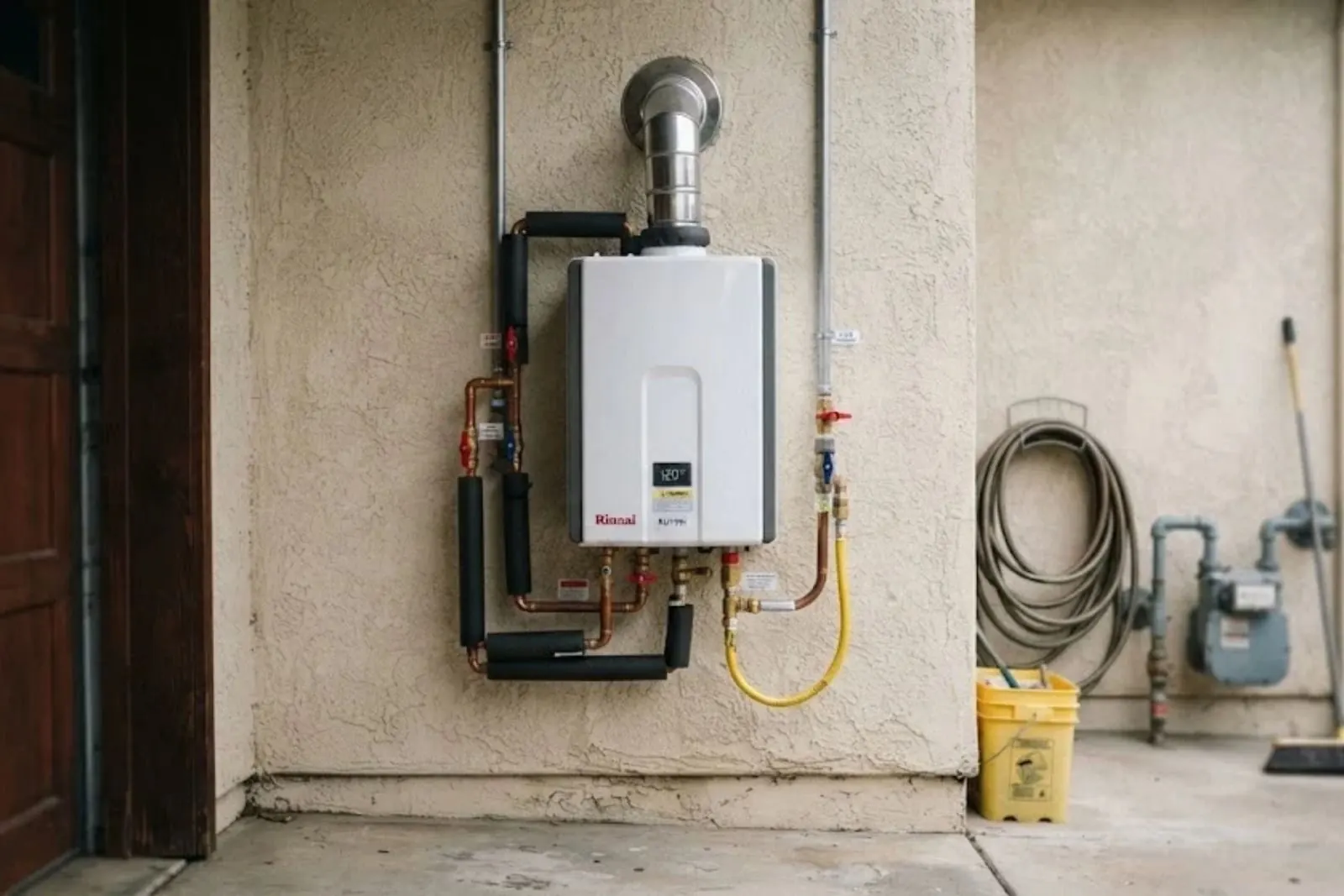
Who tankless fits, and who it does not
A tankless heater fires a burner or energizes heating elements only when a hot tap opens. There is no 40 gallon reservoir keeping water warm around the clock, so the unit can last longer and take less floor space. Many Shelbyville, Indiana homeowners ask about it after a tank fails.
It works best when you can feed it properly. Gas units often need a larger gas line and a stainless or PVC vent. Electric whole-home units can need a heavy electrical service that some panels cannot supply.
Tankless usually suits
- Households that run out of hot water with a standard tank
- Homes with space that is tight for a tank
- Owners ready to pay more up front for a longer-lived unit
- Houses where a gas line and vent route can be run
Tankless is a harder sell when
- The existing gas line is undersized and runs are long
- The electrical panel cannot carry an electric unit
- The vent route is blocked or code prohibits it
- You only need hot water at one remote tap
The planning that decides whether it works
Flow rate and temperature rise
Gallons per minute you need at the winter inlet temperature set the model. Indiana groundwater is cold in January, so the heater must raise it a long way.
Gas line capacity
A whole-home unit can draw several times the BTUs of a tank. The line from the meter must carry it, and half-inch pipe often cannot.
Venting material and route
Condensing models use PVC or polypropylene vent through a sidewall. Non-condensing models need stainless steel.
Condensate drain
Condensing units make acidic condensate that goes to a drain, often through a neutralizer.
Isolation valves
Service valves on both water lines make flushing possible. Without them, descaling is a bigger job.
If you are comparing against a standard tank, our water heater installation page covers that route, and a tank that has already failed is handled under replacement.
DIY limits on tankless installs
A tankless install involves gas piping, vent assembly and sometimes new electrical circuits. Gas leaks and carbon monoxide leaks are not forgiving mistakes. In the city of Shelbyville, only registered plumbing contractors can apply for plumbing permits, and homeowners working on a home they own and live in must get a permit first. Elsewhere in Shelby County, ask the building department.
Gas pipe size comes from sizing tables such as those in NFPA 54, the National Fuel Gas Code, and gas tankless units are certified to ANSI Z21.10.3. The practical point is that the maker's manual and those tables set the pipe and vent, not a guess. Test your carbon monoxide alarm on every level after the install.
Installing a tankless unit, start to finish
Load calculation
We total the fixtures you run at once and compare against the unit's flow at your winter inlet temperature.
Gas and electric review
Pipe size and length from the meter are checked. Condensing units also need a 120-volt outlet nearby.
Mount, vent and plumb
Wall mount, vent run with the right pitch, isolation valves, a pressure relief valve and a condensate line.
Commission and set temperature
Firing rate, gas pressure and exhaust readings are verified. The unit is set to the temperature you want at the tap.
Show you the flush ports
You see the valves and the app or display so descaling later is straightforward.
Tankless repair: error codes and cold sandwiches
Most tankless calls start with a blinking code. Typical causes are a scaled heat exchanger, a clogged inlet filter, a blocked vent or condensate drain, a failed igniter, a flame rod that needs cleaning or a flow sensor stuck from debris.
The cold sandwich is another classic. Hot water stops for a few seconds between two bursts of hot because the unit shut off and fired again. Short draws that never reach the minimum flow rate cause it, and so can low flow from a clogged aerator.
| What you see | Likely cause | What we do |
|---|---|---|
| Error code and no hot water | Ignition fault, vent blockage or flame sensor | Read the code, clean the flame rod, check vent and gas pressure. |
| Hot water fades during a long shower | Scale on the heat exchanger | Flush and descale with a pump and food-grade solution. |
| Hot, cold, hot again | Minimum flow not reached or aerators clogged | Clean fixtures and filters, check settings. |
| Water never gets hot enough | Undersized unit or low gas pressure | Measure gas pressure and re-check the flow load. |
| Condensate leak or odor | Blocked drain or full neutralizer | Clear the line and replace neutralizer media. |
If a tankless unit leaks internally or throws repeat codes, sometimes the right call is to weigh repair against a water heater repair on a tank or a swap. We tell you which.
Flush and descale: the yearly job that saves the heat exchanger
Tankless heaters run hotter in a narrower channel than a tank, so mineral scale shows up faster. Test your tap, and ask Indiana American Water for its annual water quality report to see what your supply carries. In many homes a yearly flush is the sensible interval, and a water softener changes that.
The process uses a small pump, two hoses and about 3 gallons of white vinegar or a descaling solution circulated through the isolation ports for 45 minutes or more. Then we rinse the system and clean the inlet filter.
Homes in Shelbyville with heavy scale may want treatment at the main. See water softener and filtration for how that works.
What affects tankless pricing
A tankless project has more variables than a tank swap. These are the factors we price.
Insurance does not usually cover installing or upgrading a heater. It may respond to sudden water damage from a failed unit, so check your policy and keep photos.
Safety checklist for a gas or electric tankless unit
Know these before the unit is running.
- If you smell gas, leave the house, do not touch switches, and call the gas utility's emergency line from outside.
- A carbon monoxide alarm should be on each level, and it should be tested after any gas appliance is installed.
- Keep the vent and the area around the unit clear, and do not store paint thinner or aerosols nearby.
- Turn off the breaker before anyone opens an electric unit, and leave wiring changes to a licensed electrician.
- If water is leaking from the unit, shut off its water supply valve and the power or gas, then call.
Ready to talk tankless?
Call with your current heater type, gas or electric, and where it sits. We will book a time to look at the gas line and vent route.
Tankless water heater questions for Shelbyville homes
A straight replacement of an older tankless can be done in a half day. Converting from a tank usually runs longer, often most of a day, because of gas line, vent and drain work.
Yes. A yearly flush with descaling solution is the main job, plus cleaning the inlet filter. Hard water or a lot of use can call for it more often.
Usually the flow dropped below the minimum needed to keep the burner running, or the aerators are clogged. We clean fixtures and check the flow settings.
Gas connections, venting and permits make it a licensed plumber's job. In the city of Shelbyville only registered plumbing contractors can pull plumbing permits.
Often yes. A whole-home unit draws far more BTUs than a tank and the line from the meter must supply it. We measure the run and size the pipe.
A small electric unit installed near a single sink or shower. It suits a remote bath or kitchen sink but cannot run a whole house.
It can be, with treatment. Scale clogs the heat exchanger faster, so flush every year and consider a softener on the main line.