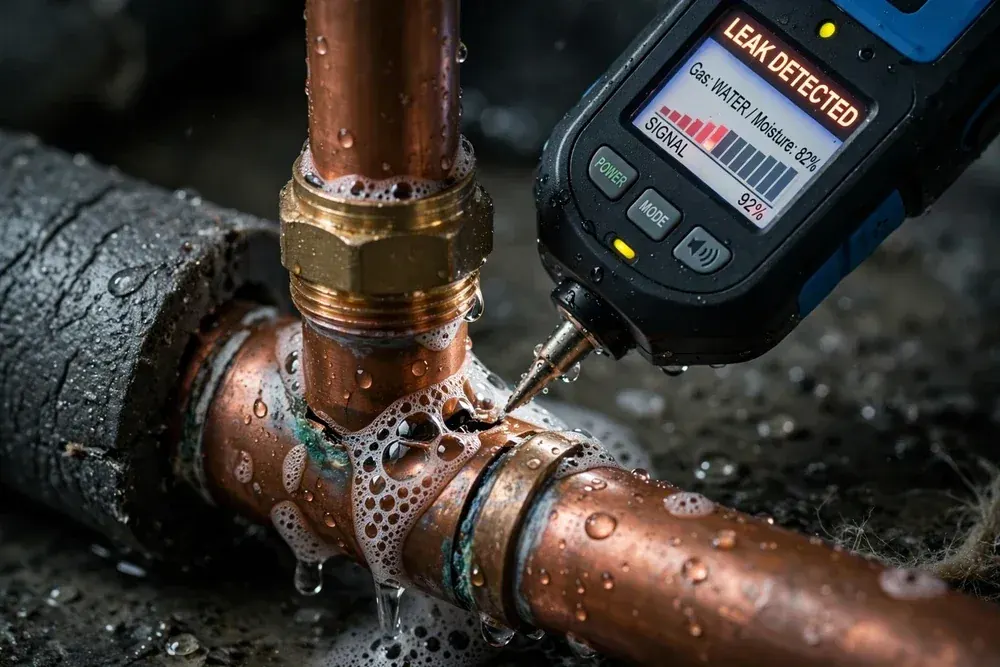
What leak detection actually is
Leak detection is a set of tests that narrow a loss of water down to one spot. A licensed plumber isolates sections of the system, watches a gauge, and then listens to the pipe with sensitive microphones until the hiss points to a location. The goal is a hole the size of a dinner plate in the drywall, not a trench across the lawn.
Most callers in Shelbyville and across Shelby County describe one of a few things. The meter keeps spinning with every fixture off, a ceiling stain keeps growing, the floor feels warm or damp, or a water bill jumps for no reason. Each of those has a different search pattern, and the sections below follow them one by one.
Once the leak is found, the repair is made with pipe and fittings approved under the Indiana Plumbing Code, so the fix meets the same standard as new work.
Meter moves with everything off
The strongest sign. Water is leaving the system somewhere between the meter and a fixture.
Bill doubled, habits did not
A steady drip of even a few gallons an hour shows up on the next statement.
Musty smell, no visible water
Damp drywall or subfloor holds odor long before a stain shows through paint.
Hissing in a quiet house
A pressurized pipe leaking inside a wall often makes a faint sound at night.
Warm spot on a floor
A hot water line leaking under a slab or subfloor can heat the surface above it.
Water meter running or a high bill
This is the most common starting point. Turn off every tap, the ice maker, the dishwasher and the washer, then look at the meter's small leak indicator or the sweep dial. If it still moves, water is going somewhere. Toilets are the first suspect, since a worn flapper can waste gallons a day without making a sound.
Drop a few drops of food coloring in each toilet tank and wait 15 minutes without flushing. Color in the bowl means the flapper leaks. If the tanks are clean and the meter still turns, the loss is in a supply line, a water heater connection, or the buried pipe running from the meter to the house.
How and when your meter is read, and what adjustments exist for a leak, are questions for your water utility. Ask them for the last few readings, then call us with the dates. Two readings a week apart tell a plumber a lot about how big the loss is. EPA's WaterSense program estimates that the average home loses nearly 10,000 gallons a year to leaks, and a worn toilet flapper is among the most common sources.
Meter still spinning with taps off?
Call the 24/7 line. A plumber can start with a pressure test the same day when schedules allow.
Slab leaks, and what is true about Shelbyville homes
A slab leak is a pipe leak under or inside a concrete floor. Not every house has the risk. Many older homes in Shelbyville, Indiana sit over a basement or a crawlspace, so their supply pipes run in joist bays where a leak can be seen and reached. Slab-on-grade foundations are more common in newer construction, and those are the homes where a pipe can leak under the floor.
Signs include a warm patch on the floor, the sound of running water with nothing on, wet carpet at an edge, and a meter that moves constantly. Hot lines are the usual culprits because heat and movement wear a copper pipe against the concrete.
Finding a slab leak starts with isolating the hot side from the cold side at the water heater, then a pressure test on each. Acoustic listening and a thermal camera narrow it to a few feet. Repair options are a spot repair through a small slab opening, rerouting the line through walls or the attic, or a larger repipe if the pipe is failing everywhere.
Ceiling and wall leaks
A brown ring on a ceiling is rarely the leak itself. Water travels along joists and pipes before it drips, so the stain can sit six feet from the source. Press the center of the stain. If it is soft or bulging, poke a small hole with a screwdriver over a bucket to relieve the water and stop the drywall from collapsing.
Plumbers check what is above the stain: a bathroom, a washer box, a supply line to an upstairs fixture, or the roof. A moisture meter and a thermal camera separate plumbing water from rain water. If the stain only grows after a storm, the roof or flashing is the cause and a roofer should look, not a plumber.
Water near light fixtures or outlets
If water is dripping from a ceiling light, a fan, or an outlet, turn off that circuit at the breaker panel only if you can reach it dry, and stay out of the room. Call a licensed electrician for any wiring that got wet. We handle the water source once the area is safe.
Crawlspace and under-house leaks
Crawlspaces hide slow leaks well. A drip onto bare soil disappears, but the humidity climbs, insulation sags, and floor joists darken. Signs from above are cold floors, a musty smell in the hallway, a bill that creeps up, and a water heater that cycles more than it should.
A plumber looks for wet insulation, mineral tracks on copper, green corrosion at fittings and rust on galvanized steel. Pipes in a crawlspace also freeze in a hard Indiana winter, since the frost line here is about 30 inches. A crack from a freeze can stay hidden until the thaw, when the line suddenly starts running.
| House type | Common hidden-leak location | How it is usually found |
|---|---|---|
| Basement home | Supply lines in joist bays, drain stubs, water heater connections | Visual check, moisture meter, pressure test |
| Crawlspace home | Fittings and old steel pipe under the floor, frozen sections | Camera and flashlight pass, listening gear |
| Slab-on-grade home | Hot lines under concrete, wall runs to the slab | Hot and cold isolation, acoustic locator, thermal camera |
| Older downtown or West Side house | Galvanized steel branches inside plaster walls | Pressure test, targeted access holes |
| Any home with a yard line | Buried pipe from meter to house | Meter test, listening on the pipe, ground microphone |
Buried line leaks between the meter and the house
Every house has a water line running underground from the meter to the foundation. When it leaks, you may see a soggy spot in the yard that stays green and wet in dry weather, a drop in water pressure, or a meter that runs with the house shut off. The line can also leak into a basement wall without showing anything outdoors.
To confirm it, a plumber closes the valve at the house and checks if the meter still moves. If it does, the leak is in the buried section. Listening on the pipe and a ground microphone then pin down the spot. Repair and replacement choices are covered on the water service line repair page.
Before anyone digs, dial 811 or visit indiana811.org at least two business days ahead. The service runs 24/7 and marks public utility lines for free. Do not skip it, even for a small hole.
Irrigation leaks
A sprinkler zone that leaks behind the backflow preventer or at a buried head can run unnoticed for weeks and spin the meter just as a house leak does. Shut off the irrigation supply and watch the meter. If it stops, the problem is in the sprinkler system. Blow-out or winterizing in fall prevents most split pipes and cracked valves.
Commercial leak detection
Shops, restaurants, and offices lose water in ways a house does not: long runs above drop ceilings, floor sinks, and flush valve toilets that stick. Our plumbers work after hours so a business can stay open, and they test by zone. For ongoing building work, see commercial plumbing. The same dispatch covers Morristown and other Shelby County towns.
How we find it without opening everything
Isolate
Close fixtures and valves in sections and watch the meter and a pressure gauge to see which branch loses water.
Pressure test
Hold the line at working pressure and watch the gauge for a drop. This separates a leak from a fixture that is simply in use.
Listen
Acoustic microphones on the pipe and floor pick up the sound of escaping water and show where it is loudest.
Image
A thermal camera shows cool damp zones in walls and warm tracks from hot lines. A moisture meter backs up the picture.
Open small
Once the spot is confirmed, the plumber cuts the smallest access hole that allows a clean repair.
When a hidden leak is an emergency
It is an emergency when water is actively flowing into finished space, through a ceiling, or around electrical equipment. Same-day and after-hours calls are what the 24/7 line is for, and a plumber can start with shutoff and containment at night just as in daytime. A slow leak with no water on the floor can usually wait for the next available appointment, but it still deserves a call within days, not weeks.
In older neighborhoods such as the West Side Historic District, built from about 1853 to 1939, galvanized supply pipe can leak at threads in several places. If one leak shows up in a pipe that age, ask the plumber how the rest of the run looks before closing the wall.
Before we arrive at a suspected leak
Four steps that limit damage and speed up the search.
Find and close the main
The main shutoff is usually where the pipe enters the house, near the meter or water heater. Turn it clockwise until it stops. If the valve is stuck, do not force it with a wrench.
Photograph the meter
Take a picture of the dial before and after 30 minutes with everything off. That gives the plumber a loss rate to work from.
Protect what is wet
Move rugs and furniture, put a bucket under a drip, and run a fan if the area is safe. Keep power off near any wet outlet.
Note when it started
Mention any recent repair, freeze, or new appliance. A leak that started after a repair often sits at that spot.
What changes the price of finding and fixing a leak
Detection and repair are priced separately in most cases, and both depend on how hard the leak is to reach.
Homeowner policies often cover sudden water damage, such as a pipe that bursts, but may not pay to find or fix a slow leak or a worn pipe. Policies differ, so read yours or ask your agent before you file.
Two local facts that affect leak hunting
Indiana 811 asks for at least two business days of notice before digging, and the service runs 24/7. A buried-line search that ends in a repair almost always needs that locate first.
The city's building code page lists a 30 inch frost line. Supply pipes buried shallower than that, or run in unheated crawlspaces, are the ones that split in a hard freeze and show up as leaks in spring.
Source type: Indiana 811 public information page and City of Shelbyville Building Codes page
Leak fixes compared
Spot repair
- Best when one fitting or one pinhole is failing
- Small opening, shorter job
- Does not fix other weak spots in the same pipe
- Good for newer copper or PEX
Reroute or repipe
- Best when the pipe leaks in several places
- More work up front, fewer repeat calls
- Can bypass a slab or buried section
- Common answer for old galvanized steel
Leak detection questions from Shelbyville homeowners
Yes. The 24/7 line takes calls at any hour, and a licensed plumber can come out for active flooding, a burst line, or a leak near electrical equipment. Same-day appointments are offered when available for slower leaks. Tell dispatch whether water is still flowing.
Turn off every fixture and appliance, then watch the sweep dial or small triangle on the meter for 15 minutes. Any movement means water is leaving the system. Ask your water utility how to read your model if the dial is unclear.
Usually. Pressure tests, listening gear and a thermal camera locate most leaks within a few feet. The plumber then opens a small access hole at that spot, not a long cut.
Only if the house sits on a concrete slab with pipes under or inside it. Many older Shelbyville homes have basements or crawlspaces instead, where leaks are easier to reach. A plumber can tell from a quick look at the foundation.
It might be, but it can also be a sprinkler zone, a downspout drain, or groundwater. Closing the main at the house and checking the meter separates them. See the water service line page for repair options.
It depends on the policy. Many cover resulting water damage from a sudden break, but not the cost of finding or repairing a worn pipe. Ask your agent before you file, and keep photos of the damage.
Yes. Restaurants, offices and shops can schedule after-hours testing so the business is not interrupted. A plumber isolates by zone and checks flush valves, floor sinks and long ceiling runs.