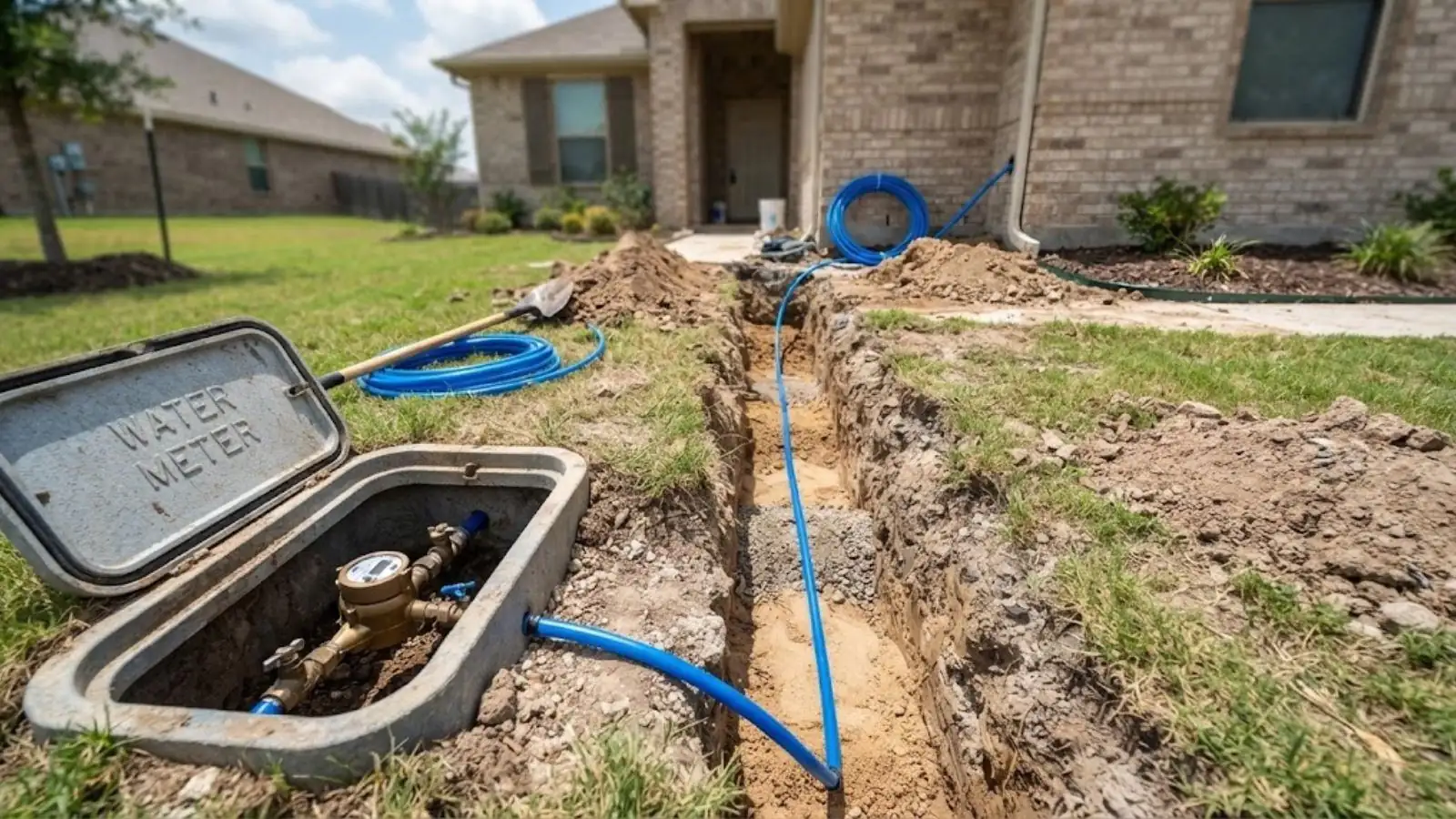
Where the service line starts and stops
The service line runs underground from the connection at the water main to your meter, and then on to the shutoff valve inside your house. In general, the utility owns and maintains the part up to the meter, and the property owner is responsible from the meter to the house. Ask your water utility exactly where that boundary sits for your address before you hire anyone to dig.
That boundary matters because a leak on the utility side is a report to them, while a leak on your side is a plumber's job. A plumber who knows the pipe can tell you which side the loss is on and why. Replacement service pipe has to be approved for drinking water under the Indiana Plumbing Code, and the standard to look for on the pipe is NSF/ANSI 61 certification.
Soggy patch in dry weather
A yard strip that stays green and wet along the line from the street to the house.
Pressure fell off
Showers weak everywhere in the house, not just one faucet, points to the main line or valve.
Meter turning, nothing on
The dial moves with all fixtures off and the house main closed.
Water bubbling at the curb
Water rising near the meter box or sidewalk suggests a break close to the street.
Dirty or sputtering water
Air and sediment can come through a cracked or partly collapsed line.
Why service lines fail around Shelbyville
Frost is the local enemy. The City of Shelbyville lists a frost line depth of 30 inches, so a service line buried shallower than that is exposed to freezing and heaving. Lines that enter the house through a cold crawlspace or an unheated garage wall freeze in the same way.
Age and material matter too. Older homes may have galvanized steel, which corrodes from the inside and chokes the flow. Others have copper or plastic that cracked from soil movement, tree roots, or a past dig that nicked the pipe. Close to the Big Blue and Little Blue Rivers the ground stays wet longer, and shifting wet soil puts extra stress on buried joints.
Pipe material rules matter when a new line goes in. Polyethylene water service tubing is made to AWWA C901, and anything touching drinking water should be certified to NSF/ANSI 61. Federal law has banned lead pipe and solder in drinking water plumbing since the 1986 Safe Drinking Water Act amendments, so an older line deserves a material check. Ask your water utility what it has on record for your address.
How a plumber confirms the line is the problem
Meter check
Close the house main and watch the meter. Movement means the loss is between the meter and the house.
Pressure gauge
A gauge on an outdoor spigot shows static and flowing pressure, which separates a restriction from a leak.
Listening
Acoustic gear on the valve and a ground microphone along the route find the loudest point.
Locate and mark
Utilities are marked through Indiana 811 before any digging starts, and the pipe is traced to its entry point.
No water, or water in the yard?
Call the 24/7 line. We can schedule a same-day visit when available and tell you how to protect the house until then.
Low water pressure: line or something else?
Low pressure at one tap is usually a clogged aerator or a bad cartridge. Low pressure at every tap deserves a closer look at the line, the main shutoff and any pressure-reducing valve near the meter. A valve that is only partly open, or a regulator that is failing, mimics a cracked line.
Check if hot water is weaker than cold. If only the hot side is slow, the water heater's inlet or sediment buildup is more likely than the buried pipe. Test your tap water if you suspect mineral scale, and ask your water utility for its annual water quality report.
Dig, bore, or line it: repair choices
Open trench repair
- Straightforward for short runs and single breaks
- The failed section is cut out and replaced
- Needs a lawn, driveway or walk to be cut and restored
- Best when the pipe is shallow and the route is clear
Trenchless replacement
- Pulls a new pipe along the old path or bores a new one
- Disturbs far less yard, patio and landscaping
- Needs entry and exit pits, and suits long runs
- Not every soil or old pipe allows it
| Situation | Usual approach | Trade-off |
|---|---|---|
| One clean break from a past dig | Cut out and splice a short section | Fast, but weak pipe next to it may fail next |
| Old galvanized line, low flow | Replace the full line to the meter | Higher cost, but fixes pressure for good |
| Frozen and split above the frost line | Replace and bury below 30 inches where possible | Needs digging, avoids a repeat freeze |
| Long run under a driveway | Bore or pull a new line | Less surface damage, special equipment |
| Leaking meter-side connection | Call the utility | Their pipe, their repair |
Dial 811 before any digging
Indiana 811 asks for notice at least two business days before you dig, and the service runs 24/7. Call 811, use 1-800-382-5544, or go to indiana811.org. Gas, electric and communication lines can lie in the same corridor as your water line, and hitting one is dangerous and costly. If you smell gas at any time, leave the area and call 911 and your gas utility.
When a broken service line is an emergency
A water line that has no water at all, a geyser in the yard, or water entering the basement is an emergency. Night calls are normal for us, since frozen lines often fail in the coldest hours. After-hours dispatch can arrange a plumber to make the line safe and turn water back on for the night when conditions allow.
Weekend service works the same way, and the 24/7 number is the one to use. For burst pipes inside the house, see burst pipe repair. Calls from Morristown and the rest of Shelby County go to the same line.
While you wait for the plumber
Steps that limit water loss and keep you safe.
Close the house main
Turn the shutoff inside your home clockwise. If water still flows, the break is before that valve and the meter shutoff may be the next stop.
Keep people off the wet area
A saturated yard can hide a washed-out hole. Keep kids and pets away from the spot until it is marked.
Do not dig
Digging without an 811 locate risks hitting gas or electric. Wait for the marks.
Store water if you can
Fill a few pots and a tub before the pressure drops further, so you have water for drinking and flushing.
What drives the price of a service line job
Service line work is priced by length, depth, and what sits on top of the pipe.
Many homeowner policies exclude wear, corrosion and freezing outside the building, and some cover buried lines only with an added endorsement. Ask your agent before assuming it is covered.
Facts that shape service line work here
The City of Shelbyville lists a 30 inch frost line depth, which is the minimum burial depth most plumbers aim for with a new line. Indiana 811 requires at least two business days of notice for digging, and its service runs 24/7. Plan any non-urgent dig around that lead time.
Source type: City of Shelbyville Building Codes page and Indiana 811 public information
Water line questions from Shelbyville homeowners
Yes. The 24/7 line is staffed at night and on weekends for broken lines, no-water calls and flooding. A licensed plumber can shut things down and make the line safe, then plan the digging with the proper locate.
In general the utility handles its main and the connection up to the meter, and the owner handles the pipe from the meter to the house. Ask your water utility to confirm for your address.
Close the main at the house and check the meter. If it still moves, the leak is in the buried section. A wet strip of lawn or a sudden drop in pressure points the same way.
Common causes are a partly closed main valve, a failing pressure regulator, a corroded galvanized line, or a leak in the service line. A pressure gauge on an outdoor spigot narrows it down.
Sometimes. Trenchless methods use small pits at each end instead of a continuous trench. Soil, line length and the condition of the old pipe decide if it works.
Yes. Indiana 811 asks for at least two business days of notice, and the service is available 24/7. It marks buried utilities so a crew does not hit gas or electric.
It can if the pipe is shallower than the 30 inch frost line or enters through a cold space. Letting a tap drip and insulating exposed runs helps. See the leak detection page if you suspect a slow loss.