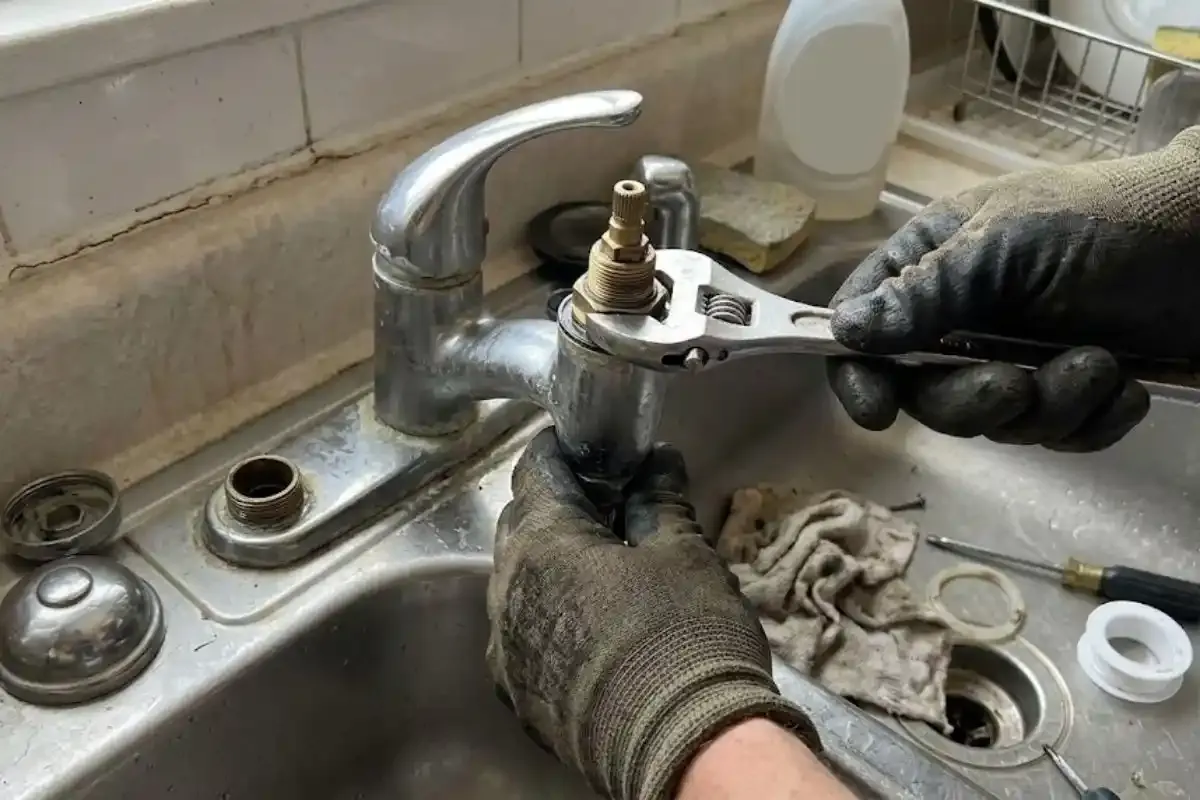
A valve that will not shut off
The scariest version of this call is a water supply that cannot be stopped. A stop valve under a sink or toilet has turned slowly for years, then snaps or spins freely when you try to close it. Water keeps running into the cabinet, and the next shutoff upstream is the main.
Go to the main valve first. Turn it clockwise until it stops. In most Shelbyville houses the main sits where the pipe enters near the water heater, in the basement or crawlspace. If your house main will not move either, the old valve is the real problem, and we can replace it along with the fixture valve.
Handle spins, nothing closes
The stem has stripped or the washer inside has failed. The valve needs to be replaced.
Valve weeps at the handle
A slow drip at the stem often means a dried packing nut that can be snugged, or a worn seal.
Crusted blue-green corrosion
Mineral buildup around a compression nut means a slow leak and a valve near the end of its life.
Water sprays under the sink
A cracked supply line or a split valve body. Close the main and call.
Valve stuck wide open
Mineral scale has locked the stem. Forcing it can snap the stem or twist the pipe.
Dripping, spraying and weak faucets
Most faucet complaints are inside parts, not the whole fixture. A single-handle faucet drips because the cartridge wore out. An older two-handle faucet drips because a rubber washer or a seat is scored. A pull-down kitchen spout sprays sideways when the aerator or the hose fitting clogs.
Weak flow from one tap is usually the aerator. Unscrew it, rinse out the grit, and soak it in vinegar if it is crusted. Test your tap if scale keeps coming back, and ask Indiana American Water for its annual water quality report.
Repair the faucet
- Cartridge, washer or seat swapped in a short visit
- Right for a fixture you like and that is otherwise sound
- Parts must still be available for the model
- Lower upfront cost
Replace the faucet
- Better when the body is pitted, cracked or corroded
- Fixes several complaints at once
- Lets you choose a new style and flow rate
- Often paired with new stop valves
When you replace a faucet, check the box for marks. ASME A112.18.1 is the standard for plumbing supply fittings, and NSF/ANSI 61 with NSF/ANSI 372 covers drinking water contact and low lead content, which matters most on a kitchen tap. EPA WaterSense bathroom faucets flow at 1.5 gallons per minute or less, against the federal maximum of 2.2.
Tubs, showers and laundry valves
Shower valves fail from the inside. A cartridge that no longer seals will leave the showerhead dribbling long after you turn it off, or swing between scalding and cold. Replacing it can mean a small access panel in the wall behind the tub. Ask for a pressure-balancing or thermostatic valve that meets ASSE 1016, which is built to limit scalding swings.
A tub spout that leaks from the diverter, a laundry sink with a loose supply, and the two valves behind a washing machine all follow the same rule. If a valve has not been turned in years, replace it while the water is off, not after it fails.
Water spraying under the sink?
Close the main and call the 24/7 line. Same-day visits are offered when available, and after hours we handle shutoff valve breaks.
Why valves fail in older Shelbyville houses
Houses in the West Side Historic District, built between about 1853 and 1939, often still have old brass or chrome stop valves and galvanized supply stubs that have been painted over many times. Corrosion inside the pipe can make the whole stub brittle. If you own a house that age, ask the plumber to look at the pipe the valve screws onto, not just the valve.
In any house, a valve that sits unused for years seizes. Turning each stop valve a quarter turn twice a year keeps the washer from sticking.
How we find and fix it
Shut down and drain
Close the main or local stop, open the fixture, and drain the line so the new part goes in dry.
Inspect the supply
Check braided lines, compression fittings, and the pipe stub for cracks or corrosion before replacing anything.
Replace the failed part
Cartridge, seat, stem, quarter-turn stop or supply hose, matched to your fixture and pipe size.
Pressure and drip test
Turn the water back on slowly, run hot and cold, and watch every joint for a bead of water.
Mark the shutoffs
Show you which valve controls what, so the next problem takes seconds to contain.
Before we arrive at a valve or faucet break
Four moves that keep the water out of the floor.
Close the house main
Clockwise to stop. If it is a lever, turn it so the handle sits across the pipe.
Open a low faucet
A tub or basement spigot drains pressure out of the pipes and slows leaks from the broken part.
Catch and mop
Put a bucket or towels under the break. Standing water near a refrigerator, outlet or power strip needs the breaker off.
Keep the broken part
Save the old valve or cartridge. Matching the size and thread is faster with it in hand.
What changes the price of a faucet or valve job
A small valve can be a fast fix or a bigger job depending on what is behind it.
Homeowner policies usually cover the water damage from a sudden supply line failure but not the worn faucet or valve itself. Check your policy language and call your agent before you file.
| What you see | First move | Then |
|---|---|---|
| Supply valve spraying | Close the house main | Call for same-day or after-hours repair |
| Faucet drips steadily | Close the stop valve under the sink | Schedule a cartridge or washer repair |
| Shutoff valve will not move | Do not force it, close the main | Replace the valve |
| Showerhead drips after shutoff | Note which side leaks | Replace the shower cartridge |
| Flooding from a split pipe | Main off, breaker off if wet near power | See burst pipe repair |
If a fixture is repaired but water pressure at every tap is poor, the issue may be the line coming in from the street, covered on the water service line page. Residents of Morristown and Fairland are within our dispatch area, see Morristown emergency plumbing for details.
Faucet and valve questions we hear in Shelbyville
Yes. A snapped supply valve or a spraying faucet gets same-day or after-hours attention through the 24/7 line. Close the house main while you wait and tell dispatch which fixture is affected.
Do not force it. A seized stem can snap and start a leak. Use the house main to stop the water and call us to replace the valve.
Usually a worn cartridge, washer or valve seat. Mineral scale can also scratch the seat. Replacing the wearing part is normally cheaper than a new faucet.
If the body is sound and parts are available, repair. If it is pitted, cracked, or constantly dripping from several places, replace it.
There is no fixed schedule, but valves that are more than a couple of decades old, crusty at the nuts, or have not been turned in years are good candidates. Replace them during another repair.
Sometimes. Old galvanized pipe corrodes inside, and a valve on a rusted stub can crack the pipe when removed. A plumber checks the stub first.
Check the aerator and the hot-side stop valve first. If those are clear, a clogged cartridge or a restricted supply line may be the cause.