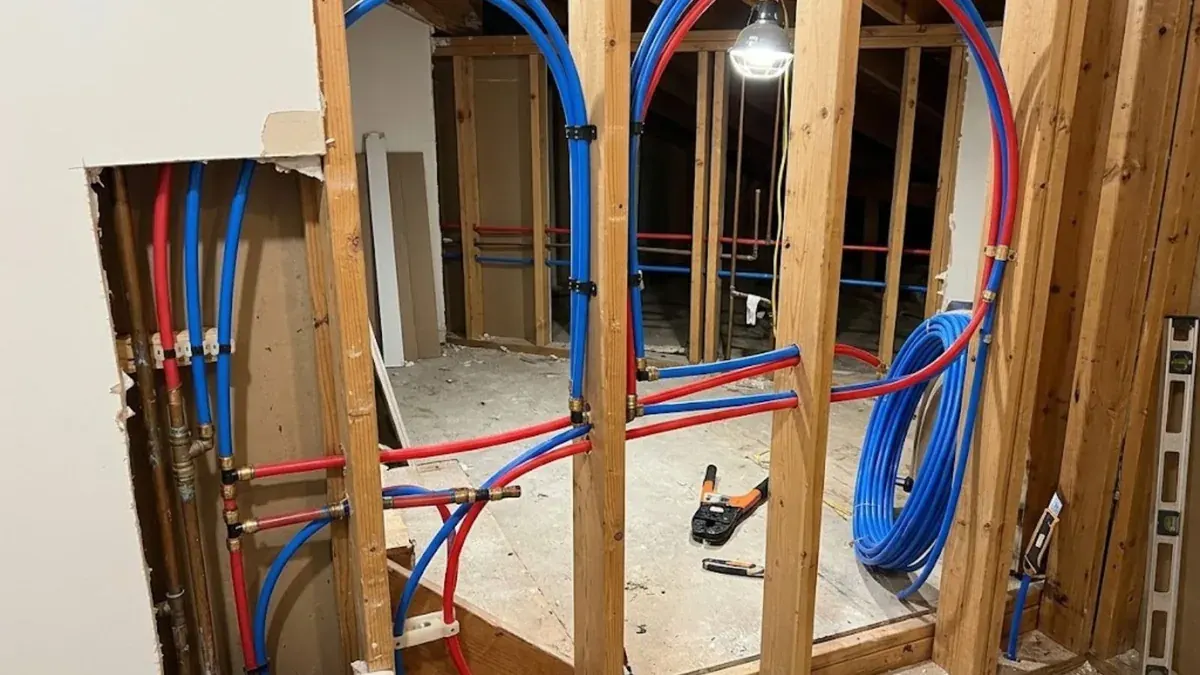
What repiping replaces, and what it leaves alone
Repiping swaps the pressurized supply pipes that carry water to your fixtures. It does not touch the drains, vents, or the main sewer line, which are separate systems. Many jobs cover the cold and hot branches from the water heater and main shutoff to every sink, tub, shower, toilet, and appliance.
A whole-house repipe is one option. A partial repipe replaces just the failing branch, such as a kitchen run or a bathroom group, and leaves newer sections in place. The right choice depends on what the pipe looks like, not on a rule of thumb. Replacement piping has to be a material the Indiana Plumbing Code approves for drinking water, and where a permit applies, the local building authority inspects the work.
Why older Shelbyville houses often need it
The West Side Historic District was developed from about 1853 to 1939, and downtown buildings go back further. Houses of that era were plumbed with galvanized steel or even older materials, and many have been patched with copper since. If your home dates to those decades, ask a plumber to check the supply pipe type before you plan a remodel.
That is a practical question, not a history lesson. Galvanized steel rusts from the inside, narrows the bore, and eventually leaks at the threads. A bathroom remodel on top of that pipe can be a poor investment if the wall will be opened again in five years.
Brown or rusty water
Especially after sitting overnight. Corroded steel sheds rust into the flow.
Weak flow at several fixtures
Mineral and rust buildup shrinks the pipe bore until little water gets through.
Pinhole leaks
More than one in a short time points to pipe wall failure, not a bad joint.
Flow dies when two taps run
A narrowed line cannot supply two fixtures at once.
Green stains on copper
Pitting or acidic water has worn the pipe wall thin.
Flaky grey fittings
Threaded joints on galvanized steel show rust blooms before they leak.
Pipe materials compared
| Pipe | Where you find it | Main concern |
|---|---|---|
| Galvanized steel | Pre-1960 houses | Internal rust, low flow, threaded joint leaks |
| Copper | Mid-century to present | Pinholes in aggressive water, high material cost |
| CPVC | Newer homes | Can turn brittle with age and heat |
| PEX | Modern repipes | Not for exposure to sunlight, needs correct fittings |
| Polybutylene (gray plastic) | Some homes built in a certain era | Known to fail at fittings, replacement often advised |
Test your tap if mineral buildup is part of the story, and ask Indiana American Water for its annual water quality report. Water chemistry is one reason copper pits in some areas and not others.
Two safety points before a repipe. Federal law banned lead solder in drinking water systems in 1986, so older copper may carry it, and a state-certified lab can test a sample from your tap.
Metal water pipe also often serves as part of a home's electrical bonding. Have a licensed electrician check it when metal is replaced with plastic.
Copper or PEX?
Copper
- Long track record
- Soldered joints last when done well
- Handles heat, no UV worry
- More labor and higher material cost
PEX
- Flexible, fewer fittings in the wall
- Faster to run through finished walls
- Resists freeze splitting better than rigid pipe
- Needs protection from sunlight and sharp bends
A plumber can also mix them, using PEX for long branch runs and copper where the pipe is exposed or near the water heater. Code requirements apply, and the Indiana Plumbing Code governs approved materials. The city's building code page lists the 2012 Indiana Plumbing Code as currently adopted.
Copper water tube is made to ASTM B88 and PEX tubing to ASTM F876. Pipe and fittings that touch drinking water should carry NSF/ANSI 61, and NSF/ANSI 372 covers lead content. Ask your plumber to show you the markings printed on the pipe.
How a repipe is planned
Survey and test
The plumber maps the supply routes, checks pipe material, and measures pressure and flow at the fixtures.
Choose scope
Whole house, partial, or one problem branch. Access through attics, basements, and crawlspaces keeps wall openings small.
Permit and notice
In the City of Shelbyville, only registered plumbing contractors can apply for plumbing permits. Homeowners working on their own home must get a permit first. Other jurisdictions vary, so ask the building department.
Install in stages
New lines go in alongside the old, then the house is switched over at a planned shutoff. Water is usually off for part of a day.
Test and patch
The system is pressure tested before drywall is closed. Wall patching can be handled by a drywall crew.
Thinking about repiping?
Call the 24/7 line to talk through the symptoms. A planned visit gives you a clear price before work starts.
Repipe or keep patching?
One pinhole leak in an otherwise sound pipe is a repair. Three leaks in two years, plus weak pressure, is a pattern. Each patch can also stress the old pipe next to it, which makes the next failure show up nearby.
A leak search first can save money. Leak detection finds out if the problem is one spot or the whole line, and your plumber can tell you honestly which it is. If the main service line from the street is the weak link, look at water service line repair first.
What decides the price of a repipe
No two houses cost the same, because the work depends on how the pipes are laid out and how easy they are to reach.
Insurance usually does not pay to replace pipe that is simply old or corroded. It may cover damage from a sudden leak. Read your policy or ask your agent before assuming either way.
Frost depth and permits
The City of Shelbyville building code page lists a 30 inch frost line depth, so any new exterior or crawlspace run should be insulated or placed to avoid freezing. For permits, the city says only registered plumbing contractors can apply, and homeowners working on their own home must get a permit first. A plumber who handles the permit saves you the paperwork.
Source type: City of Shelbyville Building Codes and Permits pages
We also serve nearby towns, including Fairland. If a pipe has already burst, start with burst pipe repair.
Repiping questions from Shelbyville homeowners
Galvanized steel is grey, threaded, and a magnet sticks to it. Copper is brown or green and a magnet does not stick. A plumber can check at the meter, water heater, or an unfinished basement.
Not always. A single leak in sound pipe can be repaired. Repeated leaks, brown water, and low pressure point to a wider problem.
It depends on house size and access. Water is typically off for part of a day, and the rest of the work is done with the supply on.
In the City of Shelbyville, only registered plumbing contractors can apply, and homeowners doing their own work must get a permit first. Outside the city, ask the building department.
If the cause is narrowed galvanized pipe, yes. If it is a partly closed valve or the street-side line, a repipe will not help.
It is generally advised. This gray plastic pipe is known for failing at its fittings, so plumbers recommend replacement before a leak, not after.
Yes. Water is shut off for a planned period, and the crew works room by room. Plan to be without water for part of one day.