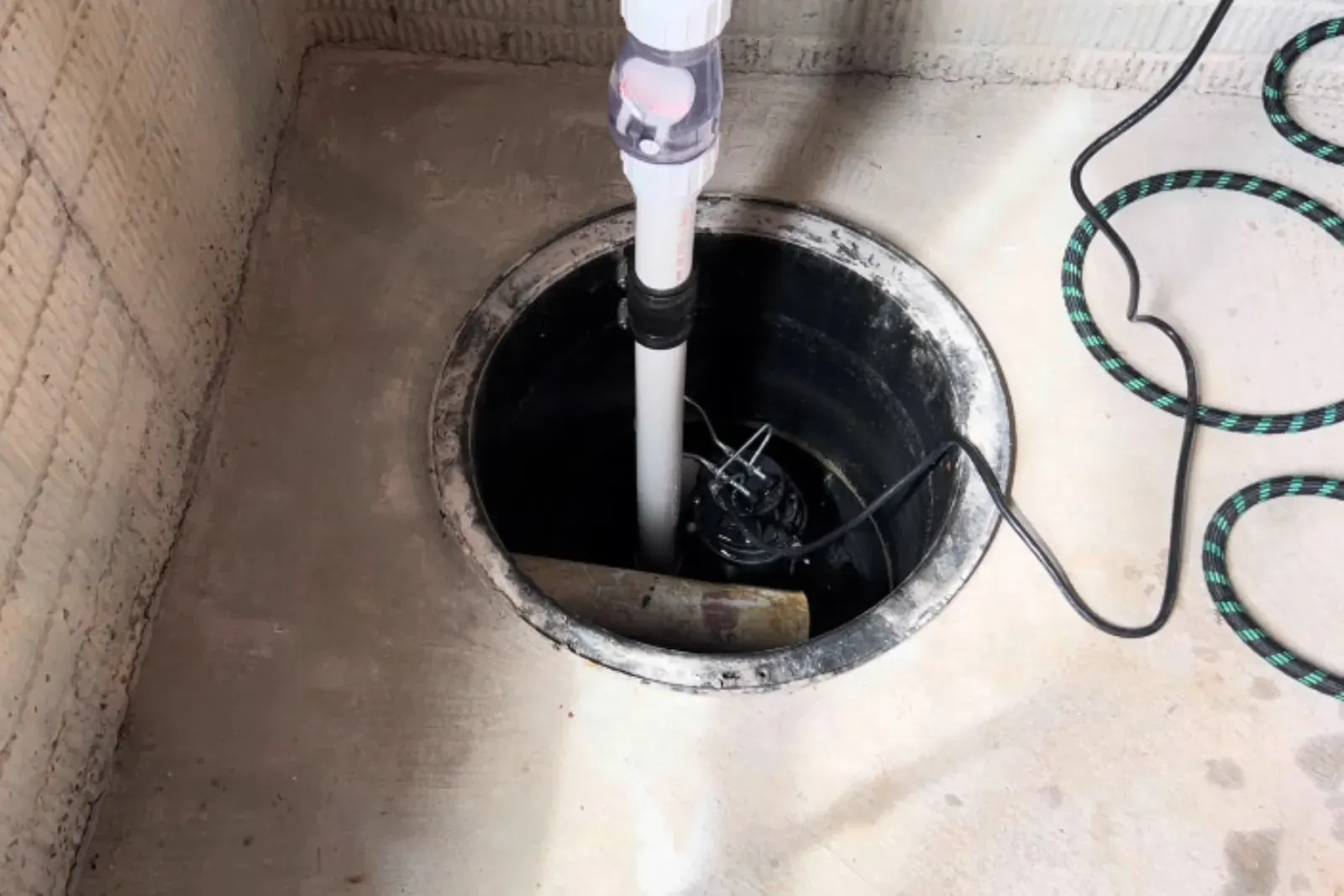
The four parts of a correct install
A sump system collects groundwater in a pit and pumps it outside before it rises through the slab. The pit, or basin, sits below floor level, usually in the lowest corner. A pump with a float switch sits inside, and a discharge pipe carries water out.
A check valve on that pipe stops water from running back into the pit when the pump shuts off. Leave it out and the pump cycles constantly. That is the most common shortcut in poor installs.
| Part | What it does | What to watch |
|---|---|---|
| Basin (pit) | Holds incoming water below the slab | Needs a gravel bed, solid walls or perforated sides, and a tight lid |
| Pump (submersible or pedestal) | Moves water up and out | Submersible runs cooler in the pit, pedestal is easier to reach |
| Float switch | Starts the pump at a set water level | Can jam against the basin wall, so it needs clearance |
| Check valve | Keeps discharge water from falling back | Install it on the vertical run, with a small weep hole below it |
| Discharge line | Carries water outside | Slope away from the house and keep it free of low spots |
Install steps a plumber follows
Pick the pit location
The lowest point of the slab or where water appears first. A plumber marks the cut, checks for rebar or radiant lines, and plans the discharge path.
Cut the slab and dig the pit
A concrete saw cuts a circle. Digging goes to the basin's depth, and about 2 inches of washed gravel goes in the bottom.
Set the basin
The basin sits level with its rim at or below the floor. Concrete patches around it, and a lid goes on to keep radon and humidity out.
Install the pump, check valve and pipe
The pump sits on the gravel or a brick, away from the wall. PVC runs up to a check valve and then out through the rim joist or foundation.
Test and add an alarm
Pour water in to trip the float. A water alarm or a battery backup is added on many installs.
Primary pump or backup too?
Primary pump only
- Lower upfront cost
- Fails when power fails
- Works well for ordinary seepage
- Needs a GFCI outlet and a dedicated circuit
Primary plus battery or water-powered backup
- Keeps pumping through an outage
- Backup pump sits higher in the basin
- Adds an alarm and a charger to maintain
- Water-powered units need adequate water pressure
Pump size follows how much water arrives and how high it must lift. Most homes use a one-third horsepower submersible, and a plumber steps up when the lift is tall or the inflow is heavy. An oversized pump can short-cycle, which wears the float and the motor.
Test the system twice a year by pouring a bucket of water into the pit. The float should rise, the pump should start, and water should leave through the discharge pipe without chattering at the check valve.
Discharge line rules of thumb
Where the water goes matters as much as the pump.
- Route water outside, away from the foundation, not into a floor drain
- Never tie a sump discharge into the sanitary sewer
- Keep the pipe pitched so it drains, not freezes full
- Leave the outlet clear of leaves and ice
- Ask the building department what your town allows, and call Indiana 811 at least two business days before trenching the discharge route
- Use a GFCI outlet and keep the cord off the wet floor
What the Big Blue River floods mean for a sump pump
The National Weather Service recorded the Big Blue River at Shelbyville cresting at 19.98 feet on April 6, 2025, the second highest on record and the highest since 1913. In March 1913, floodwater reached the first alley east of the Public Square and left over a fifth of residents homeless. That history is why a backup matters here.
A sump pump handles groundwater under and around a house. It does not hold back a river. When the river rises, groundwater rises too, so a pump may run nonstop, and a power outage then matters most. Plan for a backup, and keep the city's flood page handy.
Source type: NWS Indianapolis flood summary and Purdue/Silver Jackets 1913 flood record
The City of Shelbyville's Flood Preparedness page does not give sump pump advice. It does advise moving valuables and electronics to higher ground, and it links the FEMA flood zone map, so look up your address. Ask a licensed plumber about pit depth and backup power for your lot.
Basement taking on water now?
Call the 24/7 line. A plumber can check the pump, the float and the discharge line and tell you what is failing.
If seepage comes through walls rather than from below the slab, a pump alone may not be the answer. Our basement waterproofing page covers drain tile and wall systems. We also dispatch to Morristown and Waldron.
Sump pump installation questions
Deep enough that the pump sits below the slab level with room for the float to travel. Basins are commonly sized around 18 inches wide and about two feet deep, but the right size depends on how fast your site fills.
Yes. Without one, the water in the discharge pipe falls back into the pit each cycle and the pump runs again. A check valve with a small weep hole is standard on a correct install.
Outside, away from the foundation, and not into the sanitary sewer. Rules about drainage onto neighbors or streets vary, so ask the building department.
It depends on slab thickness, discharge routing and electrical needs. A straightforward install in a basement with a clear path moves faster than one with a long discharge run.
Not alone. A pump handles groundwater, not rising river water entering from outside. In a flood year, power loss is the main risk, so a backup helps.
The City of Shelbyville flood page says yards begin to flood near the Big Blue River at 16.3 feet, and homes near County Road 100 North and Boggstown Road at 17 feet. Check the river forecast and your flood zone if you live near them.