Is the main line the problem?
Start with a simple test. Run water at the kitchen sink and flush the lowest toilet. If the basement tub or floor drain gurgles, or water rises, the main line is blocked below every branch.
One slow fixture is a branch clog and a smaller job. Several at once means the shared line is the problem, and it needs a larger cable or a jetter at the cleanout. Cleanout access and pipe sizing on a building sewer are covered by the Indiana Plumbing Code, so a line that cannot be cleaned safely is a code question as well as a service one.
| What you see | Likely location | Urgency |
|---|---|---|
| One sink or tub slow | Branch line to that fixture | Can wait until the next day, see drain cleaning |
| Two or more fixtures slow | Main drain or the branch they share | Call soon, stop heavy water use |
| Lowest drain gurgles or rises | Main line, partly blocked | Call now |
| Sewage on a basement floor | Main line, fully blocked | Emergency, call the 24/7 line |
| Soggy yard over the pipe | Possible break past the cleanout | Same day, may need a repair |
Right now: what to do when the main line backs up
Main line backups happen at the worst times because the whole house is using water: laundry, dishes, showers. The 24/7 line is staffed for exactly that, and we send a licensed plumber with a drum machine that reaches the street. Same-day appointments are offered when available.
Until the plumber arrives, stop all water use and keep everyone out of the standing water.
Before we arrive at the cleanout
Four things that save time at the door.
Locate the cleanout
It is a capped fitting 3 or 4 inches wide, often on the basement floor near the main stack, in a crawlspace, or in a pit outside near the foundation. Clear a path to it.
Do not open it yourself
If the line is backed up, pulling the cap releases sewage into your basement. Leave that to the plumber, who comes prepared.
Turn off the washing machine
A washer drains 15 to 20 gallons a cycle. Pausing it helps more than anything else you can do.
Tell dispatch what changed
New toilet paper brand, a big laundry day, a recent tree removal or a roots history. Any of these narrows the cause.
Sewage safety while you wait
Sewage is a health hazard and not just a mess. These steps protect your household until the plumber is there.
- Keep children and pets out of the room, because sewage carries bacteria and viruses.
- Wear rubber boots and gloves if you must cross standing water, and wash your hands with soap afterward.
- Do not pour chemical drain cleaner into a backed-up main. It sits in the pipe and can burn the person who opens it.
- Stay away from outlets, cords and the panel while the floor is wet, and call 911 if anyone is shocked.
Roots, paper, grease and wipes: what blocks a main line
Tree roots
Roots follow moisture to joints in clay and old cast iron. A cutter head slices them back, though they regrow without a fix to the joint.
Grease and soap
Fat coats the wall of a 4 inch line and catches whatever follows. Heavy cases need hydro jetting to clean the full wall.
Wipes and paper buildup
Wipes do not break down in the line. A snarl forms at a joint and the paper stacks behind it.
Bellied pipe
A sag holds water and solids. Cleaning helps for a while, but the real fix is repair.
Collapsed or offset pipe
If the cable will not pass the same spot twice, the pipe has shifted or crushed.
What cleaning a sewer line involves
Reach the line
The plumber opens the cleanout, or removes a toilet if there is none. A tarp and a catch pan go down first.
Run the machine
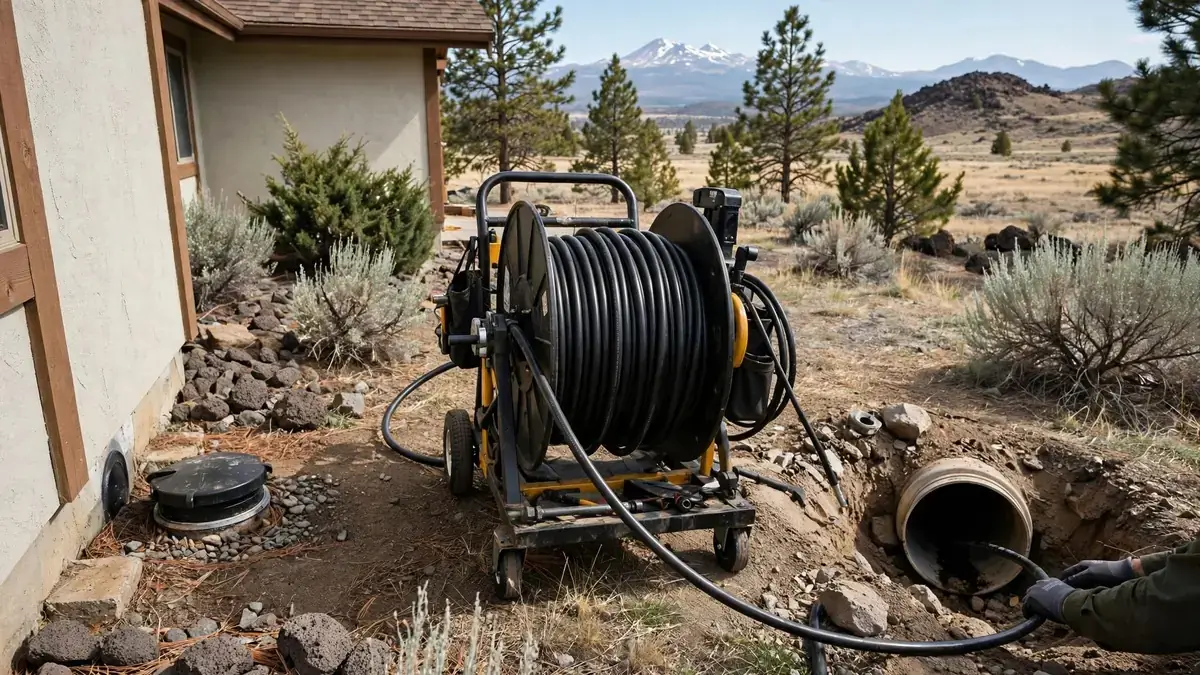
A drum machine with a 3/4 inch cable and a cutter or spear head goes in until it meets resistance. Roots, paper and grease are cut and drawn back.
Flush and test
Water is run through to prove the line flows. The plumber checks every fixture, not just the one that failed.
Look with the camera
For roots, repeat clogs or a cable that hit something solid, the camera shows what is left and whether the pipe is sound.
Whole house backing up?
Call the 24/7 line now and say how many fixtures are affected. That tells the plumber which machine to put on the truck.
Storm drains, yard drains and sump discharge lines
Not every blockage is in the sanitary sewer. Downspout drains, yard drains and driveway culvert pipes fill with silt, leaves and roots, and they back up when storms hit. A clogged storm line sends water toward your foundation and into the basement.
Check that the sump pump discharge does not tie into a clogged yard line. If your basement is the weak spot, see sump pump repair and installation as well.
The Big Blue River at Shelbyville crested at 19.98 feet in April 2025, the highest since 1913. Saturated soil pushes groundwater into cracked joints and sags, so after any high-water spell a camera look shows which lines are taking on water and which are sound.
Whose pipe is it, and who to call first
Ownership decides who pays and who you call. The City of Shelbyville runs its own sewer utility and has a Sewer Line Blockage page on its website, so a blockage out in the street main is a call to the city. On a septic system the question changes, because repairs need a Shelby County Health Department permit and an inspection.
If cleaning turns into a dig, call Indiana 811 at least two business days ahead. The service runs 24/7.
What sets the price of cleaning a sewer line
Cleaning is usually quicker than repair, and the price reflects the machine and the time, not a flat number from a phone guess.
Insurance rarely pays for the cleaning itself. Damage from a backup may be covered if your policy has a sewer or water backup endorsement, so read it and keep photos.
Keeping the main line open
- Flush only toilet paper and human waste, and bin wipes, even those labelled flushable.
- Never pour cooking grease down any drain.
- Plant trees away from the line and ask about root barriers before planting.
- Have the line cleaned on a schedule if roots cut back every 12 to 18 months.
- Add a cleanout if your house has none. It makes every future visit shorter.
We cover Morristown and the surrounding county on the same 24/7 line, so a blocked main outside the city gets the same dispatch.
Sewer line cleaning questions in Shelbyville
Yes. A sewage backup does not wait for business hours, and neither does dispatch. The line is staffed 24/7 and a licensed plumber is sent with a drum machine and a camera. Same-day appointments are offered when available.
There is no fixed interval. A line with a history of roots may need cutting every 12 to 18 months, while a newer PVC line may never need it. The camera tells you.
Roots regrow, grease re-coats, and a bellied pipe holds paper. If it returns within months, ask for a camera inspection to find out which.
Yes, by pulling a toilet or working through a vent. It takes longer. Installing a cleanout during the visit saves cost on every future call.
If a cable run from the cleanout reaches the property edge and meets nothing, the blockage may be in the main. Contact the City of Shelbyville sewer department then. Camera video shows the situation.
Yes. Downspout lines, yard drains and driveway culverts are cabled or jetted the same way. Tell dispatch where the water pools.
A stuck cable usually means a collapse, a heavy offset or a solid root mass. The camera confirms it and we discuss repair, including lining.