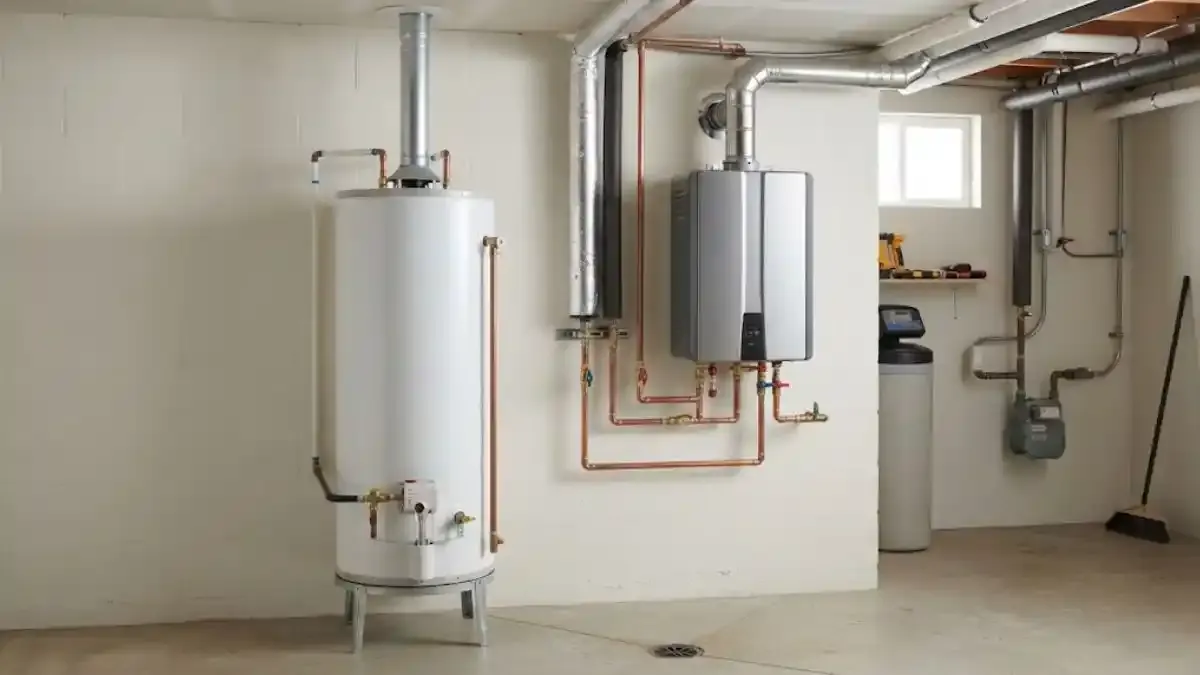
Three ways to get hot water faster
If you want hot water at one far-off sink, an under-sink point-of-use heater is the simplest install. If you want endless hot water for the whole house, you need a whole-home tankless unit and likely a gas or electrical upgrade. If the wait is the only complaint, a recirculation pump on your existing tank may fix it for less.
No option makes water instant at every tap without a trade-off. Pick by the problem you are solving, not by the word on the box. Water heater installs fall under the Indiana Plumbing Code and the National Electrical Code (NEC) for the circuit, and that standard is why wiring is a licensed job.
Point-of-use mini heater
A 2 to 6 gallon electric tank or small tankless sits under a sink. It heats only that sink's water and often plugs into a dedicated outlet.
Whole-home tankless
A wall-hung gas or electric unit that heats water as it flows. It replaces the tank and needs sizing for your fixtures.
Recirculation pump
A small pump moves cooled hot-line water back to the heater, so the line stays warm. Many homes need a return line or a crossover valve.
Smart or hybrid combos
Some homes pair a tank with a point-of-use unit at the farthest bath. It trims the wait without rebuilding the system.
Which option fits which problem
| Your problem | Best fit | Main limit |
|---|---|---|
| Long wait at one kitchen or bath sink | Point-of-use heater | Only serves that sink and needs a nearby outlet |
| Waiting at every far fixture | Recirculation pump | Needs a loop or crossover valve, adds some standby heat loss |
| Running out during back-to-back showers | Whole-home tankless | Flow rate rises with demand, so sizing matters |
| Old tank failing and you want to downsize | Whole-home tankless | Gas line, vent or panel upgrades may be needed |
| Rental or small apartment wall | Point-of-use heater | Landlord approval and a safe outlet |
How an under-sink unit is installed
Confirm the outlet and circuit
Many mini heaters want a grounded outlet within reach. If none exists, a licensed electrician adds one. Never run an extension cord to a water heater.
Shut off water and plan the tee
A plumber closes the angle stop under the sink and tees into the cold supply. Braided connectors or copper stubs then run into the heater.
Mount and fit a relief path
The unit sits on a shelf or wall bracket. A temperature and pressure relief valve needs a drain path, not a plugged outlet, and a replacement valve should be listed to ANSI Z21.22.
Fill, bleed air, then power on
The tank must be full before power is applied. A dry-fired heating element burns out fast.
Check for leaks and set the temperature
A plumber checks every joint under pressure and leaves the dial at a safe setting. See faucet and valve repair if an old angle stop will not seal.
Whole-home tankless is a bigger job
A whole-home unit changes the way the house is supplied, which is why it is a different project from a mini heater. Gas models can need a larger gas line and a sealed vent. Electric models draw heavy current and may need a dedicated breaker and new wire.
Sizing is a flow-rate question: how many fixtures run together, and how cold the incoming water is in January. A plumber measures this before recommending a model. For install details, our water heater installation page covers venting, gas lines and expansion.
Pick a mini heater when
- One sink is the real problem
- You rent or the wall space is limited
- An outlet is already near the cabinet
- You want a low-disruption fix
Pick whole-home or a pump when
- Several fixtures wait too long
- Your tank is old or undersized
- You can support gas or electrical upgrades
- Home layout allows a return line
Safety checklist before any install
Water heaters and wiring do not mix with guesswork.
- Hire a licensed electrician for new circuits, outlets or breakers
- Do not splice, extend or replace a heater cord yourself
- Shut off the breaker before anyone touches a unit
- Never power a heater that is not full of water
- Call 911 for sparking, burning smells or a hot outlet
- Smell gas near a gas unit: leave and call 911 and your gas utility
Who to ask about electrical capacity
The City of Shelbyville lists Duke Energy and Rush Shelby Energy as electric providers on its Reconnect Power page. Which one serves your address depends on where you live in Shelby County.
Ask your provider about the service you have, then ask a licensed electrician to size a circuit for the unit under the National Electrical Code (NFPA 70). Whole-home electric tankless models can draw far more current than a small panel can spare, so the answer shapes whether gas or a mini heater suits your house.
Source type: City of Shelbyville Reconnect Power page
Not sure which one fits your house?
Describe the wait, the fixtures and your current heater to dispatch. A licensed plumber can say whether a mini unit, a pump or a full swap makes sense.
We serve homes around Morristown and Waldron as well as inside Shelbyville. If your hot water is out entirely, say so when you call, because that changes the plan.
Instant hot water questions answered
No. Even a tankless unit needs a second or two to fire, and the hot water still travels through the pipes from the unit to the faucet. Point-of-use and recirculation shorten the wait, but physics still applies.
Plumbing under a sink is within some homeowners' skill, but the electrical side is not. Use a licensed electrician for outlets and circuits. In the City of Shelbyville, homeowners working on their own home must get a permit first.
It can, because it keeps hot water moving in the pipes. A timer or a demand-activated switch cuts that. Some homes need a return line, which is more work.
It works with either, but mineral-heavy water scales the heat exchanger over time. Test your tap and plan a flush schedule. Isolation valves make flushing simple.
Size by the fixture you are serving. A single bathroom sink needs far less than a kitchen sink that fills pots. A plumber matches the unit to flow and the available circuit.
The city's Reconnect Power page names Duke Energy and Rush Shelby Energy. Contact the provider on your bill, then let a licensed electrician size the circuit.