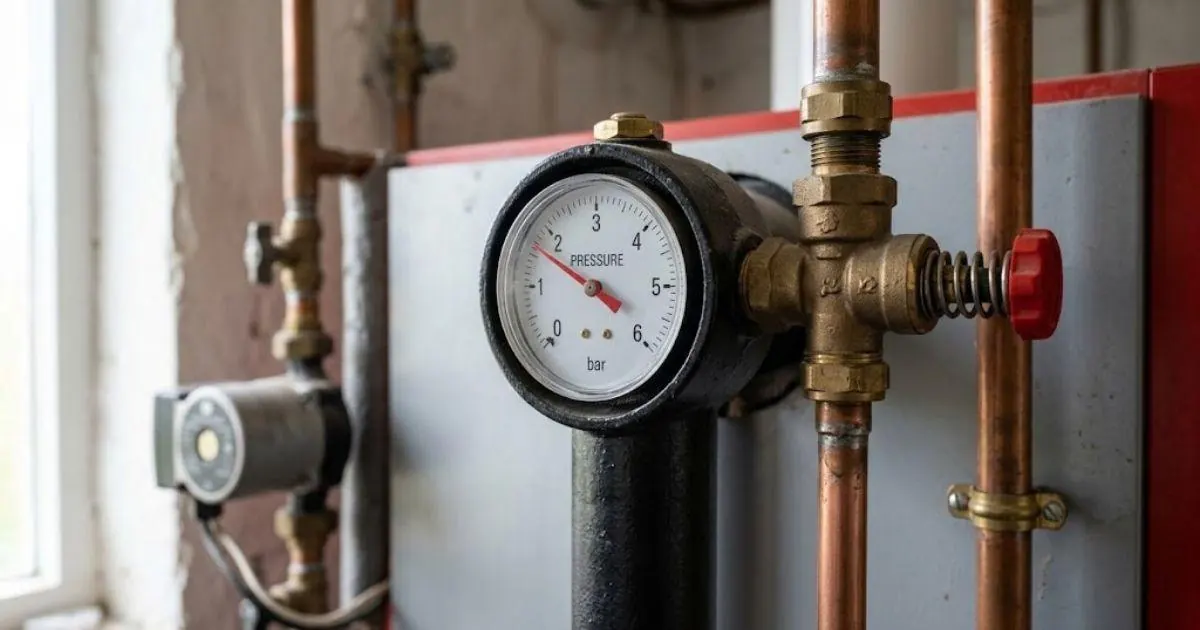
What the pressure gauge and relief valve are for
A hot water boiler heats a closed loop of water that circulates through radiators or baseboard. The loop sits at a steady pressure, usually 12 to 15 psi when cold and up to about 20 psi when hot. A pressure gauge on the boiler shows it, and a brass relief valve guards against too much.
The relief valve opens at about 30 psi on most residential boilers and lets water or steam escape so the vessel does not rupture. It is a last line of defense, built to be tested and not to be silenced. A valve that drips or discharges has either seen real overpressure or has worn out.
Do not cap, plug or tighten the relief valve
A plugged relief valve removes the one part that prevents a boiler from over-pressurizing. If it leaks, turn the boiler off at the switch, let it cool, and call a plumber. Do not try to hold the lever shut and do not thread a cap on the outlet pipe.
| Reading | What it usually means | What to do |
|---|---|---|
| Below 10 psi cold | Lost water, a leak, or a failed fill valve | Check for drips, then call a plumber |
| 12 to 15 psi cold | Normal range for most homes | Nothing needed |
| Up to about 20 psi hot | Normal expansion when heated | Nothing needed |
| Over 25 psi and climbing | Failed expansion tank or fill valve feeding extra water | Turn the boiler off and call |
| Near 30 psi, valve spitting | Valve is opening because pressure is unsafe | Turn off, leave the valve alone, call |
Common reasons the pressure goes wrong
Failed expansion tank
The tank has a rubber diaphragm that loses its air charge. Without it, hot water has nowhere to expand and pressure spikes.
Stuck auto-fill valve
A valve that keeps adding water pushes pressure up slowly over days.
Waterlogged system
Air in the lines or a leak and refill cycle can make the pressure swing.
Worn relief valve
A valve that is old or has mineral buildup can weep even at normal pressure.
Overheating
A boiler running too hot from a bad aquastat pushes pressure and temperature past limits.
Notice a pattern: the pressure goes up when the boiler is running and falls when it cools. That points to the expansion tank or fill valve. Pressure that sits too low and the boiler keeps shutting off points to a leak. Our boiler repair visits start with the gauge, the tank charge and the fill valve for that reason.
If the valve is discharging right now
Four things to do while you wait for a plumber.
Switch the boiler off
Use the service switch near the boiler or the breaker. Do not touch the discharge pipe, which can carry scalding water.
Keep people and pets back
Hot water from the discharge pipe can scald. Keep everyone away from the floor near it.
Do not plug the valve
Leave it open. Put a pan under the drip if it is safe to reach.
Smell gas? Leave
If you smell gas near the boiler, leave the building and call 911 and your gas utility from outside. Do not use switches or phones inside.
What you can check yourself, safely
Read the gauge when the boiler is cold
Note the number. It should be around 12 to 15 psi. Write it down so you have a baseline.
Read it again when the boiler is hot
A rise of 5 to 8 psi is normal. A jump of 15 psi or more suggests a bad expansion tank.
Look at the relief valve discharge pipe
It should be dry. Rust trails, white mineral crust or a damp floor beneath it mean it has been weeping.
Check for leaks and water stains
Look at the radiator valves, the pipes near the boiler and the floor below. Small drips can drop the pressure over days.
Stop there and call
Do not bleed lines, adjust the fill valve or touch the valve lever to see if it works. Those steps are for a plumber.
Basement boilers and river flood risk
Shelbyville sits at the fork of the Big Blue and Little Blue Rivers. The Big Blue crested at 19.98 feet on April 6, 2025, the second highest on record according to the National Weather Service. The city's flood page marks areas such as those near Boggstown Road and CR 100N as high-risk and advises moving valuables and electronics to higher ground.
If your boiler sits in a basement in one of those areas and floodwater reaches it, do not restart it. Water in a burner chamber, controls or gas valve can make the system unsafe even after it dries. Have a plumber inspect it before it runs again.
Source type: National Weather Service Indianapolis flood summary and City of Shelbyville Flood Preparedness page.
Relief valve dripping or no heat?
Call the 24/7 line. A licensed plumber can check the pressure, the tank and the valve, and give a clear price first.
Replacing a relief valve or expansion tank
Both parts are replaceable, but both need the system drained and the right pressure rating. A relief valve must match the pressure rating on the boiler nameplate and carry the ASME mark for heating boilers, and the discharge pipe must run to a safe point. These are not parts to swap with whatever the hardware store has.
If the boiler is old and parts keep failing, the question changes to repair versus replacement. A new boiler or new piping falls under plumbing installation, and city rules require a permit for plumbing work, so ask the building department what applies. On a gas-fired boiler, gas piping and venting follow the National Fuel Gas Code (NFPA 54), which is why that part is licensed work.
Winter is when a pressure problem turns into no heat
Indiana winters bring hard freezes, and the city lists a frost line of 30 inches. A boiler that drops pressure and locks out on a cold night leaves you without heat, and pipes in unheated spaces can freeze. Open cabinet doors on exterior walls and keep the thermostat above 55 degrees until help arrives.
The 24/7 line also covers homes in Fairland and Waldron and nearby. Describe the gauge reading and any drips when you call, and dispatch can plan the parts.
Boiler valve and pressure questions
No. A dripping valve means it has opened, is worn, or is reacting to high pressure. Turn the boiler off and have a plumber check the cause.
Most residential hot water boilers sit near 12 to 15 psi cold and rise a few psi when hot. Check your boiler's label, since some systems specify a different range.
Only if the manual shows how and the pressure is low. Adding water to a hot boiler can crack parts and mask a leak, so call a plumber if you do it more than once.
Never. Capping it removes the safety device. If the valve leaks, the fix is a new valve or fixing the cause.
Some pre-1940 houses in places like the West Side Historic District have radiator heat, though the heating type depends on the house. A plumber can identify the system and its age on site.
Do not restart it. Floodwater can damage the burner, controls and gas valve. Have a plumber and your gas utility inspect it first.