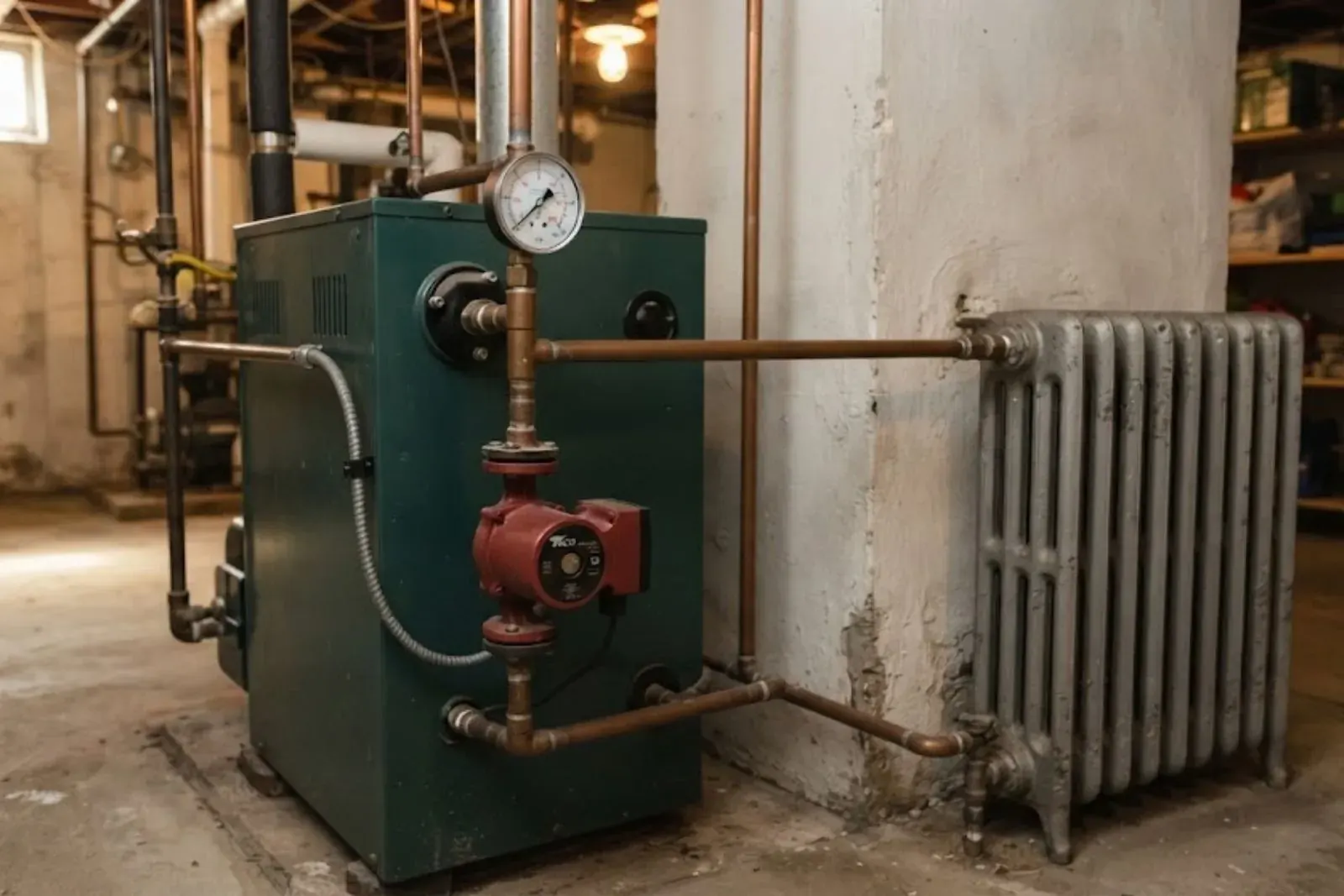
No heat in the house: what to check first
Boiler repair means diagnosing why a hot water or steam heating system is not delivering heat or is running unsafely, then replacing the failed part. In Shelbyville, Indiana, boilers show up mostly in older homes where radiators or baseboards were never swapped for forced air.
Hard freezes put real pressure on the system. A boiler without heat for a day in a house at zero can mean frozen pipes, so we treat a no-heat call in deep winter as urgent.
Check these before you call
These take two minutes and tell dispatch a lot.
- Is the thermostat set to heat and calling for heat? Replace the batteries if it has any.
- Is the boiler's power switch on and the breaker not tripped?
- Does the pressure gauge read between about 12 and 20 PSI when the system is cold?
- Is the pilot or igniter lit, and does the display show a code you can read?
- Is the gas valve open? If you smell gas, leave the house and call 911 and your gas utility first.
- Is the vent or intake pipe outside clear of snow, ice or debris?
While you wait for the plumber
Four things that protect the house and the system.
Keep the heat you have
Close doors to unused rooms, hang blankets over drafty windows and use safe space heaters only on a circuit that is not overloaded.
Protect pipes in cold corners
Open cabinet doors under sinks on exterior walls. Let a faucet drip on any line that runs through an unheated space.
Leave the relief valve alone
Do not cap, plug or tighten it. A boiler relief valve is the last safety device before the system reaches dangerous pressure.
Know the water shutoff
If a pipe or fitting is leaking at the boiler, close the cold feed valve and the isolation valves on the supply and return lines.
Leave first, troubleshoot later
Some boiler problems are not for waiting out. Treat these as a reason to get outside.
- A carbon monoxide alarm sounds, or anyone has a headache, dizziness or nausea that eases outdoors. Leave and call 911.
- You smell gas. Leave, do not touch switches, and call 911 and your gas utility from outside.
- Steam or hot water is spraying from the relief valve or a fitting. Step back, switch the boiler off if you can reach it safely, and call.
- The burner flame is mostly yellow or there is soot around the boiler. Shut it down and call.
- Never thaw a frozen pipe with an open flame.
Relief valve dripping: what it is telling you
A boiler relief valve opens at a preset pressure, commonly 30 PSI on a residential hot water boiler. If it drips or discharges, something is raising pressure past that line. A failed expansion tank is the most common cause, followed by an overfeeding fill valve, an overheated boiler or a valve that simply wore out.
Never plug the discharge. If steam or hot water is pouring out, step back, turn off the boiler and call. A replacement valve is cheap but only after we find why it opened.
Hot water heating boilers are built and rated under Section IV of the ASME Boiler and Pressure Vessel Code. A replacement relief valve must match the boiler's rating, so the pressure on the old valve's tag matters.
Pressure climbs above 25 PSI
Often a waterlogged expansion tank or a stuck fill valve pushing in extra water.
Pressure drops to zero overnight
A leak somewhere in the loop, a weeping pump flange or a failed relief valve.
Banging or kettle noise
Scale or sludge in the heat exchanger causing steam bubbles. Often needs a flush.
Radiators cold at the top
Trapped air. Bleeding the bleeder valves restores flow, but repeated airlocks mean a system fault.
Boiler cycles on and off every minute
Oversized for the load, a sticky thermostat or a flow problem. Short cycling wears parts out.
How we diagnose a boiler
We start with the cold-system pressure on the gauge, then inspect the expansion tank, the circulator pump and the zone valves. A manometer checks gas pressure at the burner. A combustion analyzer reads flue gases for safe, clean burning.
Gas piping and venting for these boilers follow NFPA 54, the National Fuel Gas Code, and the maker's manual sets the burner pressure.
Read the display and gauge
Error codes, pressure and aquastat setpoints tell us whether the problem is fuel, flow or controls.
Test ignition and gas supply
Igniter or pilot, flame sensor, gas valve and manifold pressure are checked in order.
Check circulation
Pump motor and wiring, zone valve actuators, flow checks and air purge.
Inspect safety devices
Relief valve, low water cutoff, high limit and expansion tank pre-charge.
Test the whole run
We run a full heat cycle and watch temperature rise at the radiators or baseboards before we call it fixed.
| Problem | Repair | Trade-off |
|---|---|---|
| Waterlogged expansion tank | Replace tank and reset pre-charge | Small job that stops the relief valve from dripping. |
| Failed circulator pump | Swap pump and flanges | Straightforward on most systems. Old isolation valves may also need replacing. |
| Dirty or failed flame sensor | Clean or replace | Quick fix, but repeat faults point to a deeper issue. |
| Leaking heat exchanger | Usually replace the boiler | Cracks in the exchanger cannot be safely patched. See plumbing installation for new equipment work. |
| Sludge in a steam or hot water system | Chemical flush | Restores flow but old piping may keep shedding scale. |
Old homes, old piping, and the cold snap that exposes both
Houses built before 1940 in neighborhoods like the West Side Historic District often kept cast iron radiators long after forced air became standard. Those systems can run for decades, but the oldest mains hide corrosion and clogged air vents.
If your system is original and the boiler has leaked more than once, a repair estimate that includes the cost of eventual replacement is a fair question to ask. After-hours calls get the same careful diagnosis, though a late-night visit may only make the system safe until parts are available in the morning.
What decides the cost of a boiler repair
Boiler work ranges from a ten-minute reset to a full replacement. These are the factors that move the price.
Homeowner insurance may help with water damage from a sudden pipe burst caused by frozen pipes after a failure, but it usually does not cover the boiler's own wear and tear. Photograph the damage and read your policy.
House getting cold?
Call the 24/7 line and tell dispatch the boiler type, the pressure on the gauge and any codes. We will send a plumber and tell you what to do about the pipes.
A boiler that is losing pressure may also point to a leaking line elsewhere. If the pressure drop traces to hidden pipes, see leak detection or burst pipe repair after a freeze. We also serve Fairland and the rest of Shelby County.
Boiler questions from Shelbyville homeowners in winter
Yes. Dispatch is open 24/7 and we offer same-day appointments when available. In deep cold we treat a no-heat call as urgent because frozen pipes can follow. Tell dispatch your boiler type and any codes.
Pressure is likely rising above the valve's setting, often from a waterlogged expansion tank or an overfeeding fill valve. The valve itself may also be worn. Do not cap it.
Most residential hot water boilers sit at about 12 to 20 PSI when cold and rise a few PSI when hot. Pressure above 25 or at zero means a fault.
Trapped air. Bleed each radiator with the bleeder key until water spits, then re-check the pressure. If air keeps coming back, there is a system leak or a failed air eliminator.
Often it is scale or sludge causing steam bubbles in the heat exchanger. It is not an immediate emergency, but turn the unit off if the noise is violent or steam leaks, and call.
If the heat exchanger is cracked or the boiler needs repeated repairs, replacement usually makes sense. A pump, valve or sensor failure on an otherwise sound boiler is worth repairing.
Bleeding radiators is fine. Adding water to a boiler, however, needs care because a wrong fill can over-pressurize. If you are unsure, call before opening the fill valve.