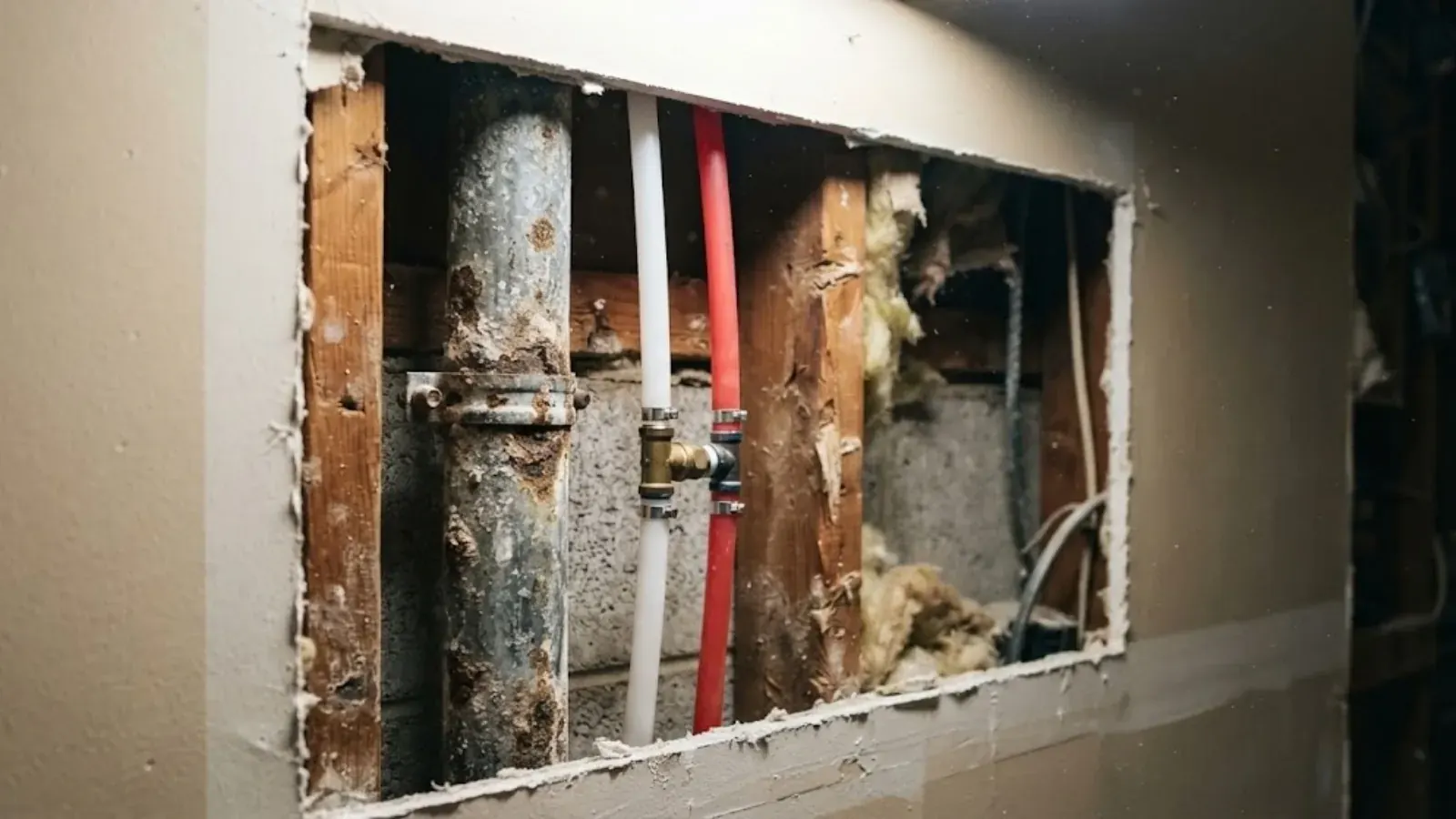
What a vent does and why a blockage shows up as noise
Every drain in your house needs air behind the water. The vent stack, a 2 to 3 inch pipe that runs up through the roof, lets that air in as water leaves, so the flow stays smooth. Block the top and the drain pulls air through the nearest trap instead, which is the gurgle you hear.
In Shelbyville, Indiana, the usual culprits are packed leaves from fall, a nest in spring, or frost that closes the opening in January. A 2 inch vent can narrow to the size of a pencil in a hard freeze, because moist warm air from the house condenses and freezes at the cold rim. The Indiana Plumbing Code sets the standard for vent size and termination, so a vent that clogs repeatedly may be undersized or mis-routed rather than just dirty.
Gurgling after a flush
The toilet or tub drain bubbles when another fixture empties. Air is being dragged through a trap.
Slow drains in several rooms
A single slow sink is a local clog. Slow fixtures on one branch point to the vent.
Sewer smell indoors
A trap siphoned dry lets gas into the room. It often follows a blocked vent.
Toilet bowl water rises and drops
The level in the bowl bobs without a flush. That is air pressure shifting in the line.
Check the easy things before climbing
Not every gurgle is a vent. A clog in the drain itself looks similar, and that is where most calls start. Run through these tests first.
Find which fixtures complain
If only the kitchen sink gurgles, the drain or its own vent branch is the issue. If the tub, sink and toilet on one line all do it, suspect the stack.
Run water in the highest fixture
Fill a bathroom sink and release it while you listen at the lowest toilet. A deep gulp from the toilet tells you air is starved.
Pour a bucket down the toilet
A sudden bucket of water pushes air out of the vent. If it drains fine with a bucket but not with a normal flush, the vent is a prime suspect.
Look at the roof from the ground
With binoculars, look for a nest, a ball of leaves or a cap of ice at the pipe opening, often near the ridge.
What you can do from the ground
- Run a drain test with a bucket
- Listen for gurgles at each trap
- Snake the fixture drain, not the vent
- Check the attic for a vent pipe that has separated or is wet
What needs the roof
- Clearing the stack with a hose or a small auger
- Replacing a cracked cap or boot
- Finding a vent stack buried in insulation
- Anything on a steep or wet roof
Roof safety before you try this
A fall is a far bigger risk than a blocked vent. Skip the roof if any of these is true.
- The roof is wet, icy, frosty or steeper than a walkable pitch
- You are alone and no one can hold the ladder
- There are power lines near the eave or the vent
- You would need to stand on the ridge to reach the stack
- You are not comfortable with heights, which is a good reason alone
How to clear a vent stack when it is safe to do so
Set up the ladder properly
Extend it three rungs above the eave, set it on firm ground, and have someone foot it. Never climb with a hose in one hand.
Look into the opening with a flashlight
Debris, a nest or ice will be visible within the top foot. Wear gloves and glasses, since nests carry mites and droppings.
Pull out what you can reach
Use a long grabber or gloved hand. Do not push debris down, because it drops into the line and plugs the horizontal run.
Flush with a garden hose
Run water down the vent for a minute while a helper watches the drains. A clear vent will swallow the water and the drains will stop gurgling.
Fit a cap, if code allows
A mesh guard keeps out nests, but a fine screen can ice over in winter. Ask a plumber which cap suits your vent size.
What the code says about vent openings
The City of Shelbyville lists the 2012 Indiana Plumbing Code on its building codes page, and that code governs how vents are sized and terminated on roofs. In practice that means a vent must go up to open air, not end in an attic, and it should sit clear of windows and fresh air intakes.
If your home was remodeled and the vent now ends under the roof deck, that is a code problem as well as a blockage risk. For work beyond cleaning, the city says plumbing permits go through registered plumbing contractors, and homeowners working on their own home must get a permit first.
Source type: City of Shelbyville Building Codes and Permits Contractors pages (code edition and permit rule).
When the problem is not on the roof
A vent can be blocked inside the wall by a sag in the pipe or by a plumber's shortcut during a past remodel. A main drain clog can also mimic a vent problem, with gurgling in the lowest fixtures first. In those cases a drain cleaning visit with a cable and a camera finds the answer faster than another roof trip.
If the house needs a new vent, such as after a bathroom addition, that is plumbing installation work and needs a permit. Air admittance valves are sometimes used where a roof penetration is not practical, but local code decides where they are allowed, so ask the building department.
Gurgling drains and no way to reach the roof?
Call the 24/7 line. A licensed plumber can test the vent from the ground and tell you if it is a clog, a vent, or both.
Keeping vents clear through an Indiana winter
Trim branches back from the roof so leaves do not collect around the pipe. Check the opening in late fall and again after the first hard freeze. A heavy rime of frost can narrow a 2 inch vent, and wider pipe above the roofline, often 3 inches, reduces the effect.
Fix any bathroom fan that dumps wet air into the attic, because that moisture condenses on the vent and speeds frosting. The same advice helps families in Fairland and out near Waldron, where the same freeze and leaf cycle applies.
Plumbing vent questions from Shelbyville homeowners
Yes. Without air behind the water, the flush runs slowly and leaves the bowl low or slow to refill. A plunger that works poorly on only one toilet while others are fine usually means a local clog, not the vent.
A drain clog backs up water. A vent clog makes gurgles and slow flow without standing water. The bucket test helps, because a big rush of water clears a partial vent restriction.
A small hand auger is fine if you are on a safe roof, but stop if you feel a hard bend. Pushing a stiff cable through an old cast iron or galvanized stack can scrape rust loose.
They can in hard freezes. With a frost line of 30 inches listed by the city, Indiana winters bring long cold snaps that coat a narrow vent opening with ice on the coldest mornings.
Heavy wind or pressure changes can pull water from a trap that has weak venting. Run water in unused drains for a minute and check the roof opening afterwards.
Most policies treat vent cleaning as maintenance, not a covered loss. Damage from a sewer backup may be excluded too, so ask your insurer about water backup coverage.