Start by testing your tap
Guessing about hardness wastes money, so measure it. Indiana American Water Shelbyville Operations is the water utility here, and it publishes an annual water quality report. Ask the utility for its latest report and compare it with what your own tap shows.
This page gives no hardness number because the report is the right source for it. Your house, plumbing and any softener already installed also change what comes out of your tap.
Look for the signs
White crust on faucets and showerheads, spotted glassware, and a film on shower doors all point to dissolved minerals.
Use a hardness test kit
Test strips or a drop-count kit from a hardware store give a quick reading. Test a cold tap that has not passed through a softener.
Request the utility report
Ask Indiana American Water for its annual water quality report for Shelbyville Operations. Look for hardness or mineral content.
Send a sample to a lab for exact numbers
A state-certified lab gives a full mineral reading. This is worth doing before buying a softener.
Compare results over time
Test again after a softener or filter is installed to confirm it works.
What sediment does inside the tank
| Symptom | Likely cause | First step |
|---|---|---|
| Popping or rumbling when heating | Water trapped under a layer of sediment | Flush the tank |
| Hot water runs out fast | Sediment takes up space and insulates the burner or element | Flush, then check sizing |
| Rust-colored hot water | Corroded tank or depleted anode rod | Inspect the anode rod |
| Pooling water under the tank | Tank leak from corrosion | Shut off water and call a plumber |
| Higher gas or power bills | A scaled burner pan or element works harder | Flush and service |
Why scale makes a tank work harder
Mineral scale insulates the heating surface. On a gas tank, sediment sits between the burner and the water. On an electric tank, scale coats the element and shortens its life.
A safe flush, step by step
Before you flush
Scalding water and gas appliances demand care.
- Turn the thermostat to pilot or vacation, or switch the electric breaker off
- Let the water cool before opening the drain
- Connect a hose that runs to a floor drain or outdoors
- Open a hot faucet in the house to let air in
- Keep children and pets away from the drain stream
- Smell gas? Leave and call 911 and your gas utility
Shut off the cold supply
Close the cold inlet valve above the tank.
Open the drain valve
Let the tank empty. Sediment often flows out as gritty cloudy water.
Pulse the inlet
Briefly open the cold valve to stir the bottom, then drain again until the water runs clear.
Close, refill and restore
Close the drain, refill the tank with a hot tap open, then restore power or gas.
If the drain valve is plastic and sticks, stop. A cracked valve turns a maintenance job into a flood. Our water heater repair crew can replace the valve and flush the tank.
The anode rod and when to replace the tank
The anode rod is a magnesium or aluminum rod inside the tank that corrodes first, so the steel does not. When it is worn down to bare wire, the tank starts to rust. Checking it every few years can add life to a tank, if the rod can be unscrewed.
A tank that leaks from the shell, or one with heavy rust and thick scale, is past saving. At that point, compare repair with a new unit, and see our guide to water heater replacement.
Flush and service when
- The tank is not leaking
- The anode rod still has metal
- Noise and slow recovery are the main complaints
- Test results show moderate minerals
Add a softener or replace when
- Scale returns fast after each flush
- Fixtures and appliances show heavy scale
- The tank shell is leaking or rusted
- A lab test confirms high hardness
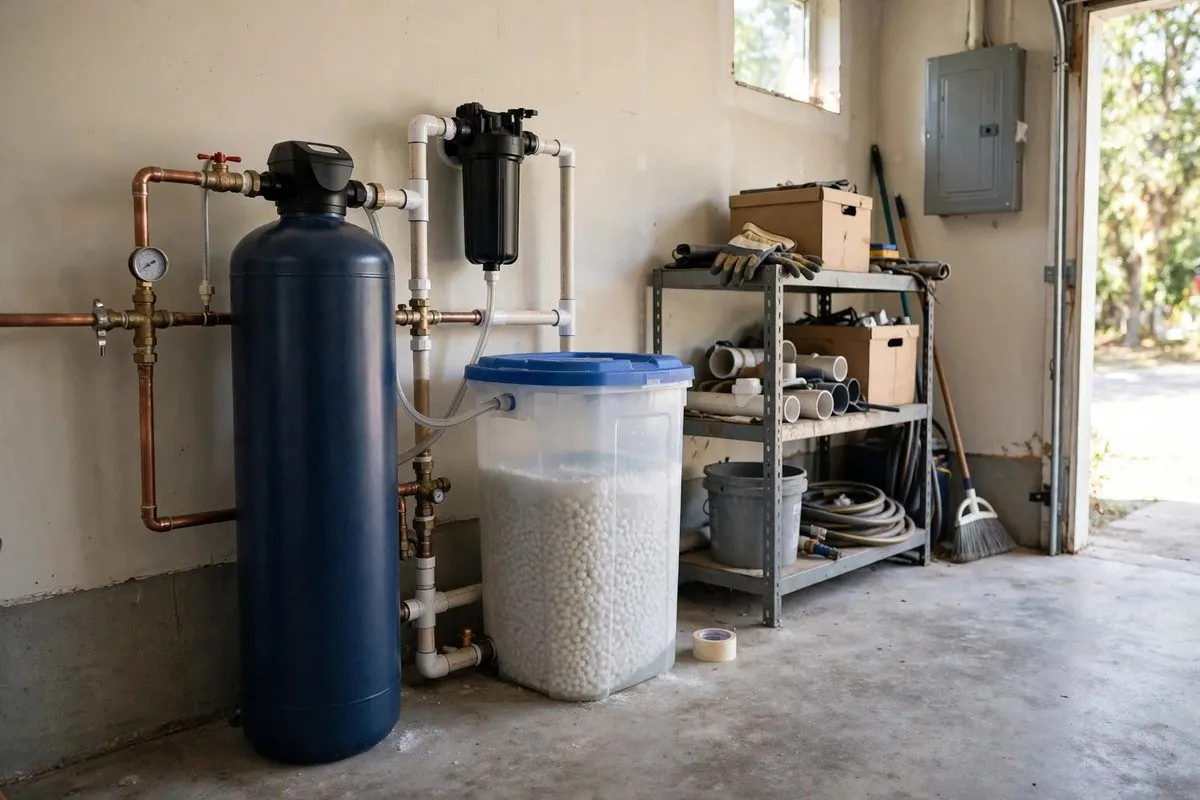
If the test does point to a softener, look for a model certified to NSF/ANSI 44, the standard for residential cation exchange water softeners. Certification means a lab tested that model against its stated claims. It does not mean your water needs one, so let your test result make that call and ask for the rated capacity in writing.
Where to get your local water numbers
Indiana American Water Shelbyville Operations is the water utility for Shelbyville, with public water system ID IN5273002. Its annual report is titled "2025 Annual Indiana American Water - Shelbyville Operations" and is meant to describe your drinking water.
Request it from the utility, and compare the minerals it lists with your own tap test. If you moved recently, ask whether your address is on the same system. Then decide on a softener from real numbers, not from advice that applies to another city.
Source type: Indiana American Water Shelbyville Operations annual water quality report
Heater loud, rusty or slow to recover?
Call the 24/7 line. A plumber can inspect the tank, flush it and tell you whether it is worth keeping.
We dispatch to Morristown and Waldron as well. A home on a private well or a different water system may see different results, so test your tap there too.
Hard water and water heater questions
A yearly flush is a common habit, and more often when you see heavy sediment. Your test results and the sounds the tank makes tell you how often it needs it.
It reduces scale from dissolved minerals, but it will not remove all sediment or fix a corroded tank. Flushing and rod checks still matter.
Not reliably. Scale, spots and soap behavior are clues, but a test kit or lab gives real numbers.
It can be, with care for hot water and power or gas. If the drain valve is stuck or leaking, call a plumber.
On electric units, scale can burn out an element. On gas units, sediment under the tank causes noise and overheating of the tank bottom. Both shorten life.
Ask Indiana American Water for the annual water quality report for its Shelbyville Operations system. If you have a private well, a lab test is the only reliable source.